

Understanding the Odds Before You Place a College Basketball Bet
You can’t consistently find value unless you know what a betting line is telling you. In college basketball, betting lines come in several common forms—point spread, moneyline, and total (over/under)—and each communicates market expectations differently. When you see a spread like “Team A -7,” the market expects Team A to win by seven points. A moneyline like “+250” for an underdog tells you how much you’d win on a $100 bet if that team pulls the upset. Totals express the market’s forecast of combined scoring.
Reading these numbers carefully helps you identify mismatches between public perception and underlying reality. For example, the spread factors in elements such as injuries, recent form, venue, and perceived coaching advantage. Your job is to peel back those layers and decide whether the posted line reflects the true probabilities or contains exploitable bias.
Quick checklist to interpret basic lines
- Point spread: Who is favored and by how many points; consider margin of victory vs. margin of defeat.
- Moneyline: How much the market values a straight upset vs. favorite; convert odds to implied probability.
- Total (over/under): Market expectation for pace and scoring—check tempo metrics and projected starters.
- Home/away impact: College teams often show larger home-court edges than pros; factor travel and altitude.
Why Lines Move and How Early Moves Reveal Upset Potential
Lines move because new information arrives or because the distribution of bets shifts. You should treat movement as a conversation between public bettors and sharps (professional bettors or syndicates). Early movement shortly after release often reflects sharp money reacting to injury news, lineup changes, or advanced metrics that the market initially overlooked. Late movement—closer to tipoff—can reflect heavy public action or last-minute roster updates.
For spotting upsets, you want to learn the difference between “public-driven” and “sharp-driven” moves. Public-driven line moves often push favorites to larger spreads as casual bettors back the name or rankings. Sharp-driven moves tend to push lines in the opposite direction (making favorites smaller or underdogs larger) because professionals find value and force a market correction.
Practical signs to watch for early
- Rapid movement away from the opening line within hours of release—often sharp activity.
- Discrepancies between books—if multiple sportsbooks diverge, imbalance signals opportunity.
- Injury or lineup clarifications posted publicly; check verified team reports and social media.
- Advanced analytics mismatches—KenPom tempo/efficiency differences or matchup-specific stats.
Integrating these reads with situational factors (rest, travel, rivalry intensity) improves your upset pick accuracy. In the next part, you’ll learn precise metrics and in-play indicators that pros use to quantify upset likelihood and the exact ways to track real-time line movement across books.
Metrics That Pros Use to Quantify Upset Likelihood
Pros don’t guess when they call an upset—they compute probabilities. Start with a handful of high-signal, objective metrics and combine them into a simple model you can run quickly before locking a wager.
- Adj. Efficiency (KenPom): The gap in adjusted offense and defense (AdjEM) is a primary predictor. Large underdogs with smaller-than-expected AdjEM gaps—especially after recent performance swings—are candidates for upsets.
- Tempo and Possessions: Upsets are likelier when the underdog’s preferred tempo forces the favorite into uncomfortable possessions per game. A mismatch in pace can compress or expand variance—increased possessions often lower upset odds for favorites.
- Variance Indicators: Turnover rate, offensive rebound rate, three-point dependency and free-throw rate influence volatility. Underdogs that generate extra possessions (offensive rebounding) or create turnovers increase their upset ceiling.
- Recent Form vs. Sample Size: Look at last-10 games adjusted for opponent strength. Short-term hot streaks combined with improving efficiency metrics are more meaningful when the sample has quality opponents.
- Matchup-Specific Stats: Defensive two-point rate, defensive three-point rate, and interior size mismatch matter. A small favorite vulnerable to inside scoring or a poor defensive rebounding team playing a rebound-heavy underdog is an exploitable alignment.
- Luck Components: Free-throw rate and turnover luck regress to the mean. If a favorite has an unsustainably high free-throw rate (or unusually low turnover rate), expect corrective movement.
Turn these into numbers: convert closing moneylines to implied probability, compute your model’s expected probability, and take the difference as perceived edge. That delta—positive and of sufficient size after accounting for vig—equals value and justifies a stake.
Tools and Techniques for Tracking Real-Time Line Movement Across Books
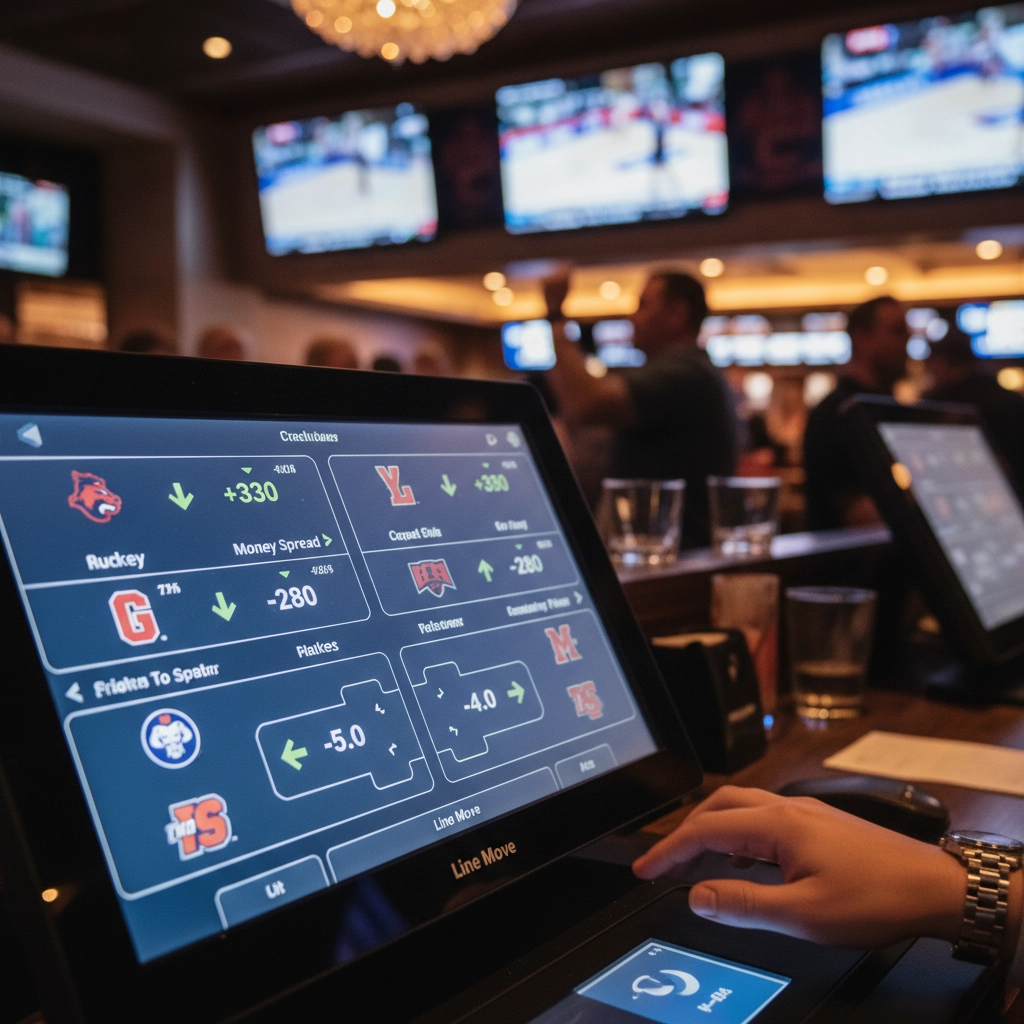
Tracking line movement efficiently separates hobbyists from professionals. Use a layered approach: market aggregators for a quick scan, dedicated trackers for live diagnostics, and direct sportsbook accounts for execution.
- Odds Aggregators: Services like OddsPortal, Action Network and VegasInsider provide side-by-side lines and historical line history. Use them to spot divergence between books and early steam.
- Line History and Steam Charts: Monitor steam charts that visualize price velocity. Rapid shifts without heavy public consensus indicate sharp action. A consistent directional move across multiple books is a stronger signal than one isolated line change.
- Money Percentage/Bet Counts: Where available, examine the percentage of money vs. percentage of bets. Heavy money on an underdog (high dollars, few tickets) is classic sharp behavior.
- APIs and Alerts: Subscribe to sportsbook APIs or third-party alert services to receive push notifications on specified thresholds (e.g., spread moves >2.5 points, ML swing >+200).
- Live-Play Monitors: For in-play betting, use real-time stats feeds (possession count, adjusted live efficiency) and watch line slippage—how far a book moves versus the market when large bets hit.
Practical workflow: set watchlists for target games, use an aggregator to confirm cross-book movement, then consult money-percent data and recent injury reports. If the model-implied probability still shows value after the move, pick your entry point and size according to your staking plan.
In-Play Indicators That Signal Upset Momentum
Once the game starts, a different set of signals matters. Key in-play indicators include pace shifts (possessions per minute), rebounding runs, early foul trouble to key players, and three-point variance. If an underdog jumps to an early lead and the favorite’s attacking efficiency drops (fewer points per possession), implied probabilities on live markets often lag the on-court reality—this is where sharp live bets appear.
- Watch the first 5–8 minutes: unexpected scoring droughts or foul issues produce the highest live-market dislocations.
- Track substitution patterns: if a coach shortens rotation, fatigue and foul trouble can widen upset chances late.
- Use small, adaptive stakes early in-game to test market pricing; increase only when your live model continues to favor the underdog after new possessions are incorporated.
Combining pre-game model edges with vigilant real-time monitoring gives you the best shot at identifying true value upsets rather than chasing noise.
Putting the Plan into Action
You now have the framework: metrics to quantify upset potential, tools to monitor line movement, and in-play indicators to exploit. The next step is execution—build a lightweight checklist, test your model with small stakes, and automate alerts so you don’t miss sharp moves. Maintain discipline: log every wager, review misses objectively, and iterate on the components that produce consistent edges. For quick cross-book checks and historical line data, consider an aggregator like OddsPortal to speed decision-making.
Final Betting Checklist
- Confirm model edge vs. implied probability after vig.
- Verify no late injury or lineup updates; check trusted sources.
- Scan cross-book movement and money-percent indicators.
- Size bets using a predetermined staking plan and bankroll rules.
- Record the bet, rationale, and outcome for later review.
Frequently Asked Questions
How can I tell if a line move is sharp-driven or public-driven?
Look for rapid movement across multiple books, a disconnect between percentage of bets and percentage of money (heavy dollars on few tickets), and moves that occur immediately after release or following verified news. Sharp-driven moves often come quickly and consistently across major books rather than slowly drifting in one direction.
When is live betting on underdogs most advantageous?
Live bets are most valuable in the early minutes if the underdog builds an unexpected lead, or when possession-based metrics (pace, points per possession) diverge from pregame expectations. Use small adaptive stakes initially and increase only when your live model continues to show value after additional possessions and lineup patterns confirm the change.
What staking approach should I use for upset picks?
Use conservative, percentage-based staking tied to bankroll (e.g., 1–2% for higher-variance upset bets), adjust size based on edge confidence, and avoid chase behavior after losses. Track returns by bet type to refine stake sizing for games where your model historically outperforms the market.