
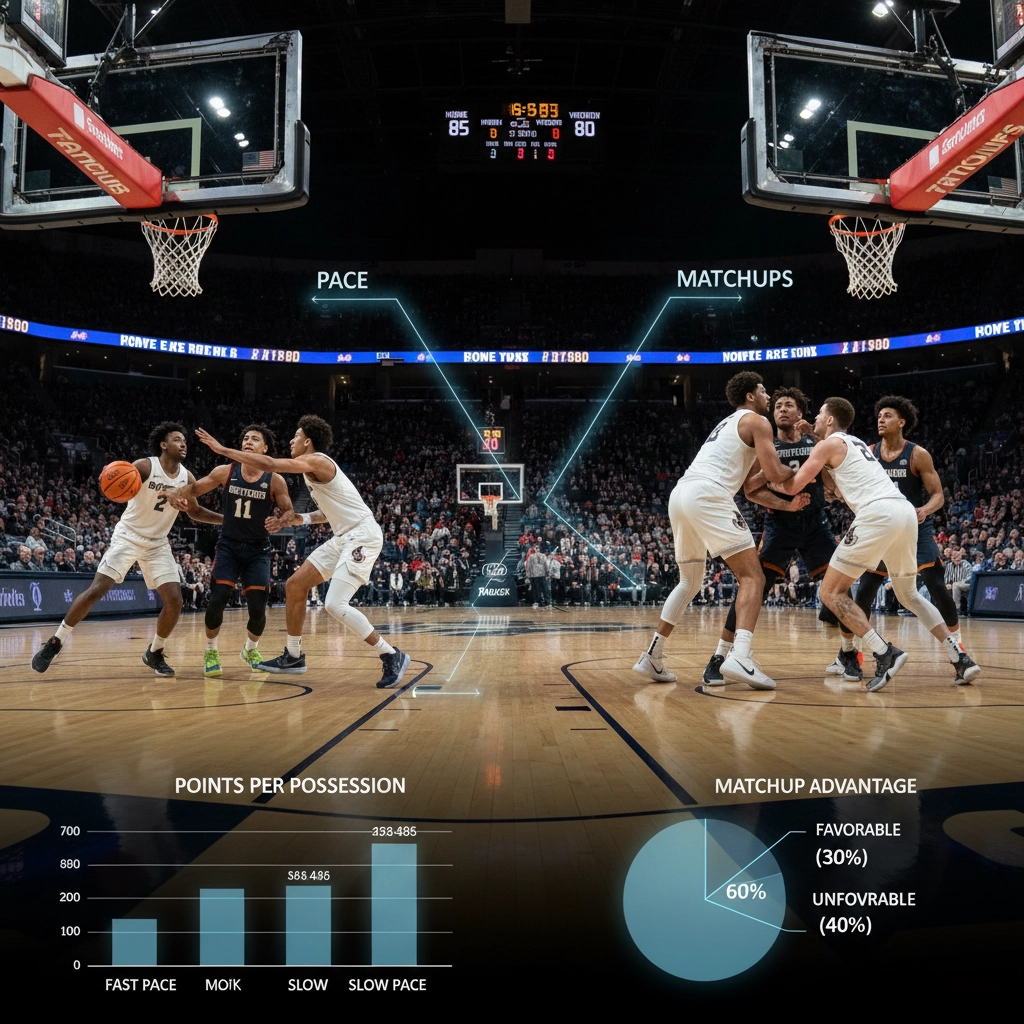
Understand how game tempo sets the baseline for scoring
You often focus on star players and box score totals, but the game’s pace — the number of possessions per 48 minutes — is one of the clearest predictors of how many points you’ll see. When you watch a fast-paced team, you should already expect more shot attempts, more transition chances, and therefore more scoring opportunities. Conversely, slow, deliberate teams reduce possessions and compress scoring into fewer, often more contested attempts.
Possessions, tempo, and simple math
At its core, scoring is possessions × points per possession (PPP). If you increase possessions by pushing tempo, even modest PPP yields more total points. That means when you evaluate a matchup, the first thing to check is both teams’ pace — the combined tempo largely determines the game’s scoring ceiling.
- Higher possessions: More shots, more free throws, more offensive rebounds and second-chance points.
- Transition scoring: Fast teams create quick opportunities before defenses set, raising PPP on average for those possessions.
- Shot quality vs. quantity: Faster pace can lower individual shot quality, but the volume often outweighs the drop in efficiency.
- Foul rates and stoppages: Pace affects how often the clock stops — more fouls and timeouts can further influence total scoring.
See how specific matchups amplify or dampen scoring
After you account for pace, matchups explain deviations from expectation. Matchups are about how two teams’ strengths and weaknesses interact — personnel, styles, and coaching decisions all matter. A high-tempo team facing elite rim protection will score less in the paint than their pace would suggest, while a slow-paced team with dominant isolation scorers can inflate PPP despite fewer possessions.
Key matchup factors that change point totals
- Sizing and length: Teams with long wings and shot-blocking centers limit high-percentage inside shots, pushing offenses to lower-efficiency perimeter attempts.
- Perimeter defense vs. shooting: If a great shooter faces weak closeouts, three-point attempts and makes rise — increasing total points even if pace is moderate.
- Pick-and-roll dynamics: Mismatches created by switch schemes or poor hedging can produce easy buckets or free throws, spiking scoring in short stretches.
- Bench depth and fatigue: You should watch how starters match up late in games; tiring defenders concede simpler scoring chances and help raise totals.
- Foul trouble and officiating tendencies: Players in foul trouble alter matchups and create free-throw scoring spikes, especially in close games.
Practical matchup scenarios you can use immediately
If you pair a top-10 pace team with a defense that struggles versus the three-pointer, expect an above-average total. If a slow, defensively disciplined team plays a halfcourt-oriented opponent that lacks interior scoring, expect a lower total. These patterns help you form expectations before looking at box scores and betting lines.
Next, you’ll learn how to measure and quantify these effects using specific metrics — such as possessions per 48, offensive/defensive efficiency, and matchup-adjusted statistics — to make more accurate scoring predictions.
Quantify tempo and scoring with concrete metrics
To move from intuition to prediction, use a small toolkit of standard stats that translate directly into expected points. The most useful are pace (possessions per 48 minutes), offensive rating (points scored per 100 possessions), and defensive rating (points allowed per 100 possessions). Together they let you convert possessions into expected points with one straightforward relationship: expected points = possessions × points per possession.
How to apply this in practice:
- Estimate possessions: A simple, commonly used estimate for game possessions is the average of the two teams’ pace numbers — e.g., (paceA + paceB) / 2. Pace is reported per 48 minutes, so this gives an expected possessions-per-game value directly.
- Convert offensive rating to points per possession: Offensive rating (OffRtg) is points per 100 possessions, so points per possession = OffRtg / 100.
- Compute team points: Team A expected points = expected possessions × (OffRtgA / 100). Repeat for Team B and sum them for a total.
Example: Team A pace 98, OffRtg 112; Team B pace 94, OffRtg 105. Expected possessions = (98 + 94) / 2 = 96. Team A points ≈ 96 × 1.12 = 107.5; Team B ≈ 96 × 1.05 = 100.8. Expected total ≈ 208.3. That base-line figure is where matchup-specific adjustments are layered on.
Make matchup adjustments: defense, role players, and situational factors
Raw OffRtg and pace assume league-average opponents. To refine, adjust each team’s offensive output based on the opponent’s defense and the specific ways they score or concede points.
- Defensive friction: Replace raw OffRtg with a matchup-adjusted figure. A simple method: adjusted OffRtg = OffRtg × (league average defensive rating / OpponentDefRtg). If the opponent defends better than average, this scales your offense down.
- Area-specific rates: Look at transition PPP, paint PPP, and three-point rate/efficiency. If Team A excels in transition and Team B ranks poorly at preventing transition, bump expected PPP for the possessions likely to be in transition (steal and turnover rates help estimate frequency).
- Bench and fatigue: Account for rotation strengths. If a starter is out and the backup defense is significantly worse (on-off splits), adjust defensive multipliers upward. Back-to-backs and travel also depress defensive effectiveness and can increase totals.
- Foul and free-throw impact: Use free-throw rate (FT/FGA or FTA per 100 possessions) to estimate how many points will come from the stripe; officiating tendencies and star players in foul trouble can add quick scoring variance.
Use lineup and play-type data to catch the deviations
Team averages mask where games truly swing. Lineup-level metrics and play-type PPPs reveal where a matchup can create a big deviation from expected totals.
- Lineup matchups: Compare the primary offensive lineup’s PPP against the opposing defensive lineup’s PPP. Small-sample but high-impact mismatches (e.g., a high-usage ball-handler matched against a weak on-ball defender) often produce short stretches of unusually high scoring.
- Play-type mismatches: Examine isolation, pick-and-roll, catch-and-shoot, and off-screen PPP vs opponent allowances. If a team’s highest-volume play type exploits the opponent’s weakest area, boost that team’s expected PPP proportionally to the frequency of that play type.
- Practical checklist before locking a number: confirm injuries/rotations, check referee styles (some crews call more fouls), adjust for home/away splits, and re-run the possession × PPP calculation using adjusted OffRtg values.
These steps give you a repeatable process: establish baseline possessions, convert adjusted offensive ratings into points per possession, then layer in matchup- and lineup-specific tweaks to move from a broad expectation to a realistic game-total projection.
Putting the method into play
Turn the framework into a repeatable workflow: start with the baseline possessions × PPP calculation, add matchup and lineup adjustments, then record the difference between your projection and the actual total. Treat each game as a data point — small-sample noise is expected, but patterns emerge when you log possessions, play-type splits, rotation changes, and officiating context. Over time you’ll learn which adjustments consistently under- or over-shoot and can calibrate multipliers accordingly.
Keep risk management in mind: projections are probabilistic, not certainties. Use confidence bands (e.g., ±1 standard deviation) around your projections and be explicit about assumptions such as expected minutes, foul rates, and transition frequency. For reference definitions and common metrics, see the Basketball Reference glossary.
Frequently Asked Questions
How do I estimate the number of possessions in a specific matchup?
A practical approach is to average the two teams’ pace figures: (paceA + paceB) / 2, where pace is possessions per 48 minutes. Adjust that baseline for known tempo influences — coaching style, likely rotations, and game script (blowouts or late-clock plays) — before converting to expected points.
What’s the best way to factor injuries and rotation changes into a projection?
Use on/off and replacement-level splits where available. If a starter is out, substitute the backup’s offensive and defensive ratings and play-type tendencies into your calculations for the minutes the backup will play. Increase variance when rotation certainty is low (e.g., coach experimenting, late scratches).
Can pace alone predict whether a game will be high-scoring?
Pace is a major driver but not sufficient by itself. Fast possessions increase scoring opportunities, but points per possession (influenced by defense, matchup edges, three-point shooting, and free throws) determines actual scoring. Combine pace with adjusted PPP and matchup-specific play-type analysis for reliable projections.