
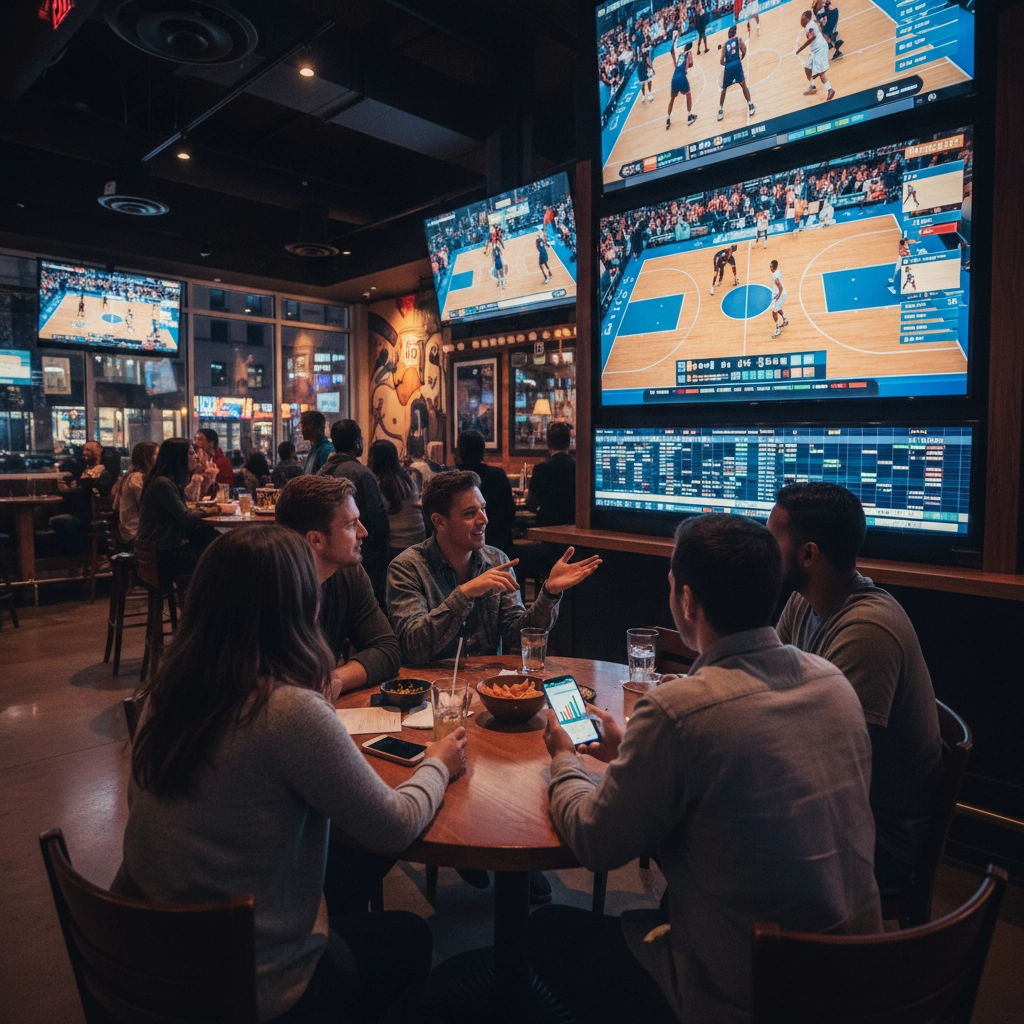
Why live NBA betting demands a different mindset
When you place a bet during an NBA game, you’re not using the same tools or instincts as you would pregame. Live (in-play) betting compresses information and reaction time: odds update every second, momentum swings can flip spreads, and new markets appear for quarters, halves, and player props. Understanding the mechanics behind those real-time odds and the types of in-play wagers available is the first step to betting more effectively.
How streaming data and market forces shape live lines
Bookmakers adjust live odds based on several fast-moving inputs. You should be aware of the main drivers so you can anticipate or react to changes:
- Score and clock: The most obvious factors — a three-point lead with two minutes left looks very different than the same lead in the first quarter.
- Player availability: On-court injuries, fouls, and rotations alter expected team performance immediately.
- Momentum and on-court matchups: Hot streaks, defensive stops, and coaching adjustments can make lines lag behind the reality on the floor.
- Betting flow: Heavy money on one side will nudge odds as books balance liability.
- Vig and implied probability: You need to factor the bookmaker’s margin into any live assessment of value.
Which in-play markets offer the best opportunities early in the game
Not all live markets are created equal. Early in games you’ll find distinct pricing inefficiencies and tactical openings; knowing where to focus saves time and reduces risk.
Primary live markets and when to use them
- Moneyline: Useful when a favorite loses a key player or starts cold; the line can overreact in the first quarter.
- Point spread: Look for momentum-driven swings. Early fouls or a fast start by the bench can make the spread mispriced before books fully adjust.
- Totals (over/under): Court pace and shooting percentages matter early — if the game begins unusually fast or slow, totals can offer value.
- Quarter/half lines: Short segments are more volatile; if you can read rotations and matchups, those markets often present mispricings.
- Player props: Props reset daily as players accumulate minutes and stats; early trends (e.g., a starter benched or a backup in foul trouble) create quick edges.
Practical early-game tactics you can use right away
- Watch line movement for the first few minutes — sudden shifts often signal public money or insider news.
- Prioritize markets you can monitor closely; avoid wide menus that dilute focus.
- Use multiple books for live line-shopping; small differences in seconds can flip an expected value calculation.
- Limit stakes early while you assess pace, rotations, and momentum to avoid chasing misreads.
With these fundamentals and early-market tactics in place, you’ll be ready to move into concrete strategies, bankroll rules, and live-read techniques that help turn in-game observations into consistent profit opportunities.
Mid- and late-game live strategies: exploiting time, fouls, and situational nuance
Once the game crosses the halfway mark, different forces dominate pricing. Clock management, foul trouble, and intentional late-game tactics (fouling, timeouts, lineup changes) create short windows of predictable mispricing if you spot them fast.
- Use the clock as an edge: Books price remaining time into spreads and totals. If a team leads by 4 with 90 seconds and has the ball versus a team that rarely scores quickly, the market may overvalue a comeback. Conversely, if the trailing team has an elite late-clock scorer or a quick foul-drawing guard, the market can underprice their chances. Translate scenarios into rough conversion rates (e.g., how often that team scores before a foul) and bet when your calculated probability exceeds the implied odds.
- Exploit intentional fouling and free-throw variance: When a coach starts fouling, totals and player rebounding/assist props shift. If a poor free-throw shooter is sent to the line repeatedly, consider betting unders on their point prop or over on rebound/assist props for teammates who see increased touches. Books sometimes lag in adjusting individual props compared to team totals.
- Leverage timeout and substitution patterns: Veteran coaches use timeouts to alter momentum. If you know a coach always calls a late timeout to set a play or rest a key, anticipate that substitution pattern and act on markets (e.g., player minutes or quarter lines) before the book fully digests the change.
- Small spreads are high leverage: The last 2–3 minutes often compress spreads into fractions. A half-point or single-point swing can flip value. Ladder your stakes—take a small initial position and add if the market moves further in your favor and situational indicators hold.

Player-prop focus: identifying high-probability in-play prop bets
Player props are among the most fruitful live opportunities, because minutes and usage swings create acute mispricings. The key is to track immediate signals that change a player’s expected box-score production.
- Minute-tracking beats sample-size stats: A starter sitting with two early fouls or a coach leaning on a bench scorer for a hot stretch creates short-term volume spikes. Bet props tied to counting stats (points, rebounds, assists) when minutes become predictable.
- Matchup-based props: If a primary defender gets injured or picks up fouls, target the offensive player who benefits. Defensive matchups matter more live than season averages—one weak perimeter defender can inflate a shooter’s live-point expectancy for several minutes.
- Usage-rate math: Quickly recalculate a player’s expected shot attempts after rotations. For example, if a lead ball-handler exits and the backup historically takes 30% of team possessions when on-court, their shot-based props often offer value before books reprice.
- Shop across books for micro-edges: Different operators adjust props at different speeds. Having several accounts and setting prop alerts lets you pounce on stale lines—an extra rebound or half-point in a player O/U can be the difference between +EV and a push.
Bankroll rules and stake-sizing specifically for live action
Live betting requires tighter risk controls than pregame because you’re reacting to noisy, fast-moving information. Adopt conservative, systematic staking to preserve capital and exploit real edges over time.
- Smaller unit size: Use a reduced unit for live bets—commonly 0.25–0.75% of your roll per moderate-confidence in-play wager. Reserve larger (up to 1–1.5%) stakes for rare, high-confidence situations backed by clear situational data.
- Fractional Kelly for scaling: If you use Kelly, apply a fractional version (10–25% Kelly) in-play to limit volatility. Live bets are higher-variance; full Kelly will blow up a bankroll quickly.
- Predefine stop-loss and take-profit rules: Decide in advance how many consecutive losses you’ll tolerate in live markets and cap exposure per game. Likewise, consider cashing out partial positions when a market moves strongly in your favor to lock small guaranteed profits.
- Record and review: Track time-stamped bets, the observable cue (injury, substitution, foul sequence), and outcome. Live edges are subtle; systematic review reveals which signals are repeatable and which are noise.
Putting strategy into practice
Live NBA betting is a skill that improves with disciplined practice, timely information, and careful risk management. Stay patient, protect your bankroll, and treat each in-play decision as an experiment: note the cues that worked, the ones that didn’t, and refine your ruleset accordingly. Use reliable data feeds to confirm on-court events and rotations quickly—official resources like NBA advanced stats can help validate matchup and minute trends while you’re learning.
- Start small and scale only when a pattern proves profitable over many instances.
- Keep a timestamped log of live bets and the exact in-game signal that prompted them.
- Use multiple books for line-shopping and set automated alerts for player status or lineup changes.
- Respect game context—coaching habits, foul strategy, and late-clock specialists matter more live than on paper.
Above all, remember that live betting rewards discipline more than bravado. Make conservative choices, iterate on what works, and let repeatable edges—not short-term variance—drive your staking decisions.
Frequently Asked Questions
When is a live moneyline bet preferable to an in-play point spread?
Choose the live moneyline when a clear event shifts win probability—such as a key injury, ejection, or a sudden bench rotation that materially reduces a team’s ability to score or defend. Moneylines react faster than spreads in short windows, so they’re useful when the immediate outcome (win/lose) differs sharply from the implied probability priced into the spread.
How much smaller should my unit size be for live bets versus pregame wagers?
Live bets are noisier and more volatile, so reduce your typical pregame unit by at least half. Many experienced live bettors use 0.25–0.75% of bankroll for routine in-play wagers and reserve 1–1.5% only for rare, high-confidence scenarios backed by clear situational data.
Are player props generally more profitable live than pregame?
Player props can offer more frequent mispricings live because minutes and usage change quickly. When a starter sits, a backup’s usage spike can create a short-term edge. However, props require fast math and lineup tracking—without disciplined monitoring and multiple books for comparison, the perceived edge can evaporate.