
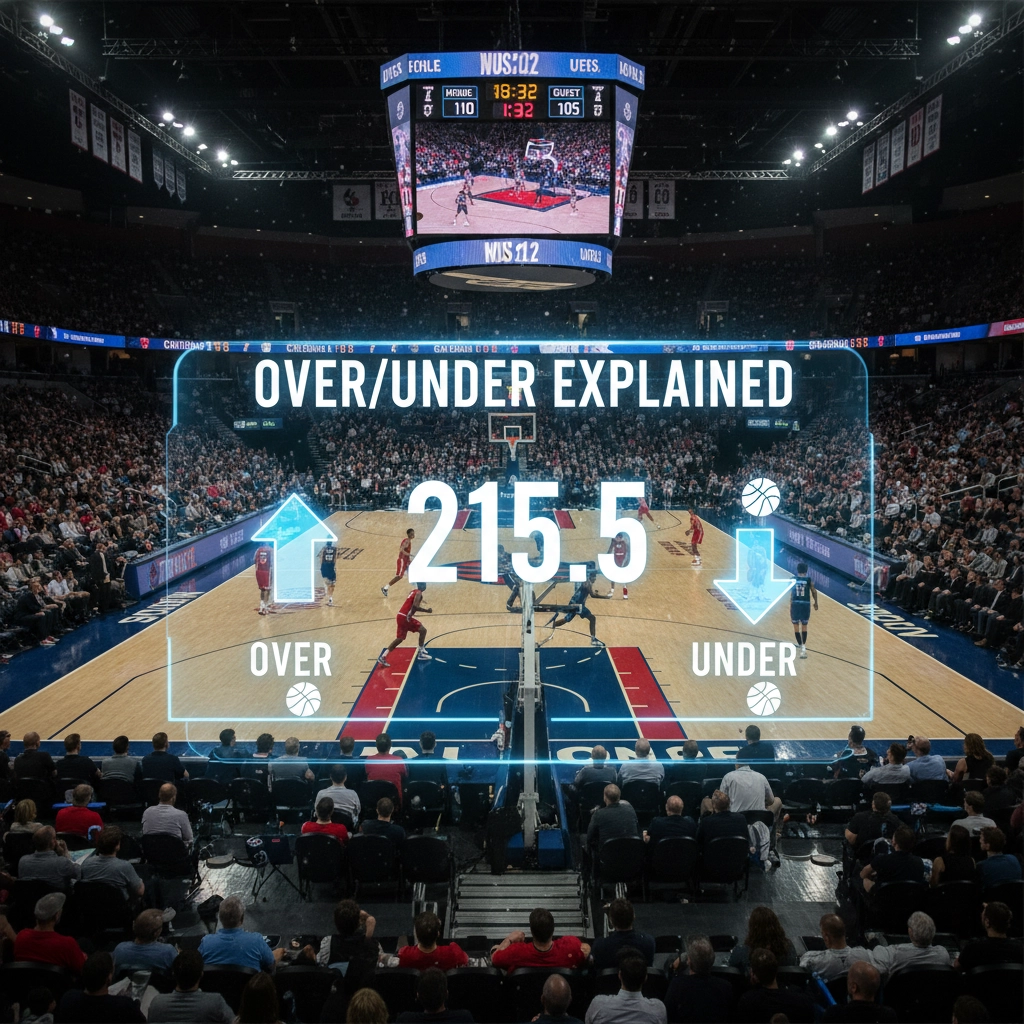
How the over/under affects the way you view a basketball game
When you look at a sportsbook’s board, the over/under (also called the “total”) might be the first number that grabs your attention. Unlike point spread bets that require one team to win by a certain margin, the over/under asks a simpler question: will both teams combined score more or fewer points than the number posted? Understanding this number changes how you watch the clock, substitutions, and late-game fouling — because you’re betting on the pace and scoring output, not the winner.
As you read, think about how a single substitution or a defensive adjustment can swing a total. The over/under connects directly to game flow: faster pace and poor defense tend to push totals up, while slow tempo and tight defense press totals down. That context is the foundation for making informed over/under wagers.
What the over/under actually means and how sportsbooks arrive at a total
Defining the bet and the basic math
At its simplest, the sportsbook sets a number — for example, 215.5 — representing the combined points expected from both teams. If you bet the Over, you win when the final combined score is 216 points or higher; if you bet the Under, you win when the total is 215 points or fewer. The half-point (.5) is commonly used to prevent ties, which are known as pushes.
How bookmakers create the number
Bookmakers don’t guess the total at random. They use models that combine historical team data, player availability, pace metrics, and public betting tendencies. Key inputs typically include:
- Recent scoring averages for each team (points per game on offense and points allowed on defense).
- Pace of play — possessions per 48 minutes — since pace dictates scoring opportunities.
- Injury reports and rotations: a key scorer or defensive anchor missing can shift expected totals significantly.
- Venue and schedule factors: home/away splits, travel fatigue, and back-to-back games affect effort and shooting efficiency.
- Public money and sharp action: books adjust lines as bets come in to balance liability and reflect perceived correct prices.
Why lines move and what that means to you
Lines move for two main reasons: new information (like injuries or lineup changes) and betting volume. If heavy money comes in on the Over, sportsbooks may raise the total to discourage further one-sided action. Conversely, a late injury to a high-usage offensive player often drops the total. As a bettor, tracking the timing and source of movement helps you judge whether a change is driven by informed sharps or by casual public bets.
Grasping these fundamentals — what the total measures, the inputs behind it, and why it moves — sets you up to evaluate a game beyond the surface number. In the next section you’ll learn how to interpret line movement, use basic statistics to estimate your own totals, and decide when the Over or Under represents value for your bankroll.
Reading line movement: timing, sources, and what to trust
When a total moves, your first question should be: why? Not all movement is created equal. Early movement — shifts that happen when a market opens or within the first few hours — often reflects sharp bettors and syndicate action. Late movement, especially in the hours leading up to tipoff, is more commonly driven by public money or last-minute news (injuries, scratch reports, travel hiccups).
Here’s a practical way to interpret movement:
- Early sharp movement up or down usually signals information or a model edge that the market has respected. If a total rises quickly after open, a sharp group may be betting the Over because they project more possessions or a hot matchup offensively.
- Slow, steady movement throughout the day often comes from correlated public bets—think parlays and casual Over plays. That doesn’t mean it’s wrong, but it’s less reliable as an information signal.
- Sudden late drops tied to an injury or lineup update are actionable if you can confirm the roster change and assess how it alters scoring. A non-shooting defender missing might push the total up; a scorer sitting usually pushes it down.
One final rule: track closing line value. If you consistently get better totals than the closing number, you’re finding value — regardless of whether movement looked “sharp” at the time.
Quick math: estimating a sensible total in minutes
You don’t need a PhD to make a back-of-envelope projection. Start with two simple inputs: each team’s points per possession (PPP) and an estimated number of possessions for the game. A fast method:
- Estimate possessions per team by averaging their recent pace metrics (possessions per 48). For a single-game estimate, use (PaceA + PaceB) / 96 × 48 to get game possessions. A simpler shortcut is averaging the two teams’ recent possessions per game.
- Multiply each team’s PPP by your possession estimate to get projected points for that team.
- Add the two projections for a total. Compare that number to the sportsbook’s total and assess the gap.
Example: if projected game possessions = 100, Team A PPP = 1.10 and Team B PPP = 1.05, projected total = (1.10 + 1.05) × 100 = 215. If the book lists 218, the Under might offer value — but only after you check adjustments such as pace changes, injuries, or recent shooting variances.
Situational adjustments that tilt a total’s true value
Numbers are a starting point. Context converts them into an edge. Consider these common situational adjustments:
- Rotation news: a bench scorer getting extra minutes can add several points to the expected total; a key bench defender out can have the same effect.
- Back-to-back and travel: expect slower pace and lower efficiency on fatigued teams, especially in the second game of a back-to-back.
- Coaching styles and late-game incentives: some coaches deliberately slow late minutes for wins or rest starters in garbage time, suppressing totals; others rely on aggressive late-game offense.
- Foul trouble and free-throw discrepancies: teams that attack the rim or draw fouls tend to inflate totals — check foul rates and opponent free-throw rates.
Blend the quick math with these adjustments, and you’ll be better equipped to spot when the posted total is mispriced and when to pull the trigger on Over or Under.
- Before you bet a total, confirm lineup and injury news—especially last-minute scratches that change who handles the ball.
- Run a quick possession × PPP check to see if the market is within a reasonable band of your projection.
- Note how the line has moved and whether that movement came early (sharp) or late (public/news-driven).
- Account for context: travel, back-to-backs, coaching tendencies, and foul/FT rates that can skew scoring away from raw numbers.
- Track your closing-line value over time; consistent +CLV is the clearest sign you’re finding edges.
Putting it into practice
Successful Over/Under play is less about predicting the exact score than about following a repeatable process: build a simple projection, adjust for credible context, and only act when the market diverges enough to justify the risk. Stay disciplined with stake sizing, track your results (including closing-line value), and be honest about whether an edge is real or just noise. For tools and historical pace/efficiency data to refine your projections, consult resources like Basketball-Reference.
Frequently Asked Questions
How can I tell if line movement is driven by sharp bettors or the public?
Look at timing and magnitude. Early, large moves shortly after market open often reflect sharp action; slow, steady moves through the day tend to be public-driven. Cross-check with injury/lineup news—sharp moves without news are more likely to be informed modeling or syndicate activity.
What’s the quickest way to estimate a sensible total during a short window?
Use a back-of-envelope: average both teams’ recent possessions to estimate game possessions, multiply each team’s PPP by that number, and add them. Even a rough 5–10 possession error usually gives you a clear sense if a sportsbook total is meaningfully off.
Which situational factor most commonly causes sportsbooks to misprice totals?
Late rotation and minutes changes—especially unforeseen bench promotions or a starter resting—are the most frequent source of mispriced totals. These changes can shift pace and scoring responsibility in ways models that rely on season averages may not immediately capture.