
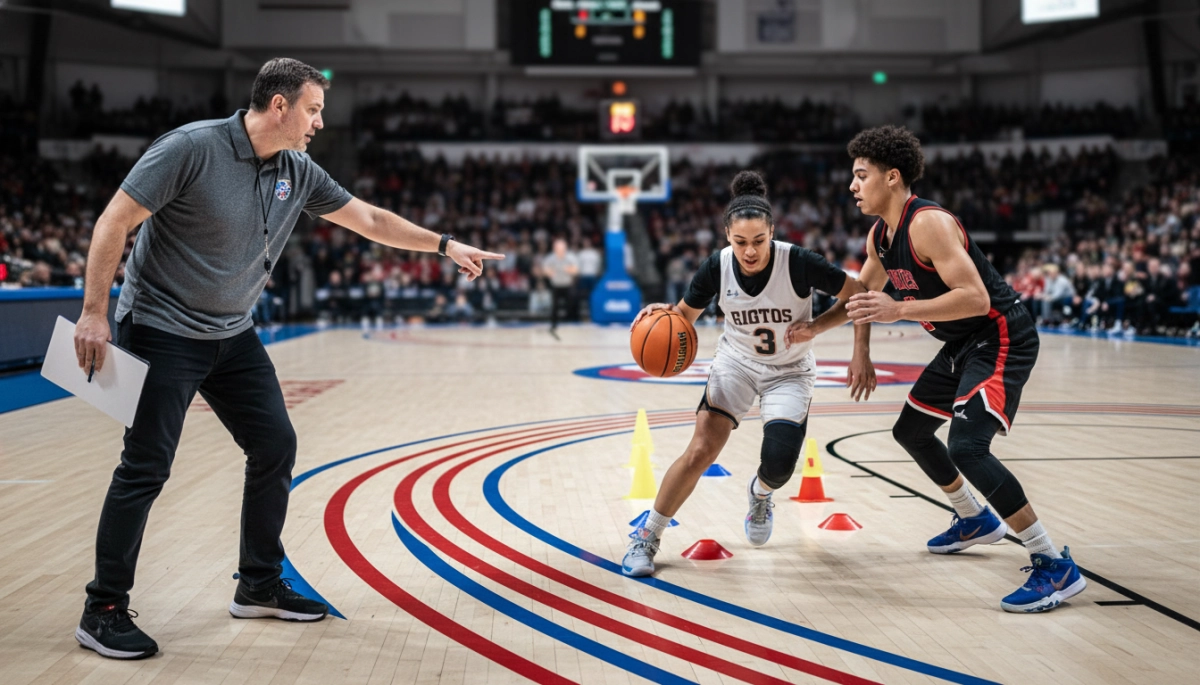
How ABA sharpens guard instincts when the game speeds up
You coach guards to think, act, and create under pressure. Applied Behavior Analysis (ABA) gives you a practical, evidence-based toolkit to shape those split-second decisions into reliable playmaking behaviors. By treating skills as observable behaviors, you can break complex plays into teachable parts, arrange environments that cue the right responses, and use reinforcement to build consistency.
Core ABA principles you can apply to on-court coaching
Start by viewing each desired playmaking action as a behavior you can measure and modify. Use these ABA concepts as your foundation:
- Task analysis: Break plays into discrete steps—recognize pressure, secure dribble, scan, choose pass or shot, execute. Each step becomes a teaching target.
- Prompting and fading: Give prompts (verbal cues, visual markers, or guided motion) to elicit the correct choice, then systematically reduce prompts so the guard responds independently in live play.
- Reinforcement: Reinforce accurate reads and successful executions immediately. Use praise, playing time, or tangible tokens depending on your team culture and the player’s sensitivity to feedback.
- Shaping: Reward successive approximations—if a player improves from panicking to controlled dribbling, reinforce that step toward a full target behavior.
- Antecedent control: Structure practice environments (court spacing, defensive pressure, shot clock constraints) to cue the behaviors you want to see.
- Data-driven feedback: Collect simple, objective data each rep (e.g., decision time, turnover, assist) so you can track progress and adjust teaching targets.
Designing pressure drills that teach decision-making, not just mechanics
When you design drills, think in terms of the three-term contingency: antecedent, behavior, consequence. Arrange the drill so the antecedent mimics game pressure, the target behavior is measurable, and the consequence reinforces the desired choice.
- Antecedent strategies: Add noise, countdowns, crowd simulation, closeouts, or extra defenders to create time pressure and force choices you want practiced.
- Measurable behaviors: Define what counts as a correct response—completing a drive-and-kick within three seconds, a successful skip pass under pressure, or a late-clock pull-up with balance.
- Consequences and schedules: Use immediate, specific feedback. Start with continuous reinforcement for correct reads, then shift to variable schedules to improve transfer to games.
- Shaping drills: Sequence reps from low to high pressure—start with decision-only reps (no defender), add passive defenders, then active defense and clock constraints.
With these ABA foundations in place, you can create drills that accelerate learning and make calm play under pressure the default response—next, you’ll get drill templates, measurement methods, and ways to individualize tactics for different guard profiles.
Drill templates that produce game-ready playmakers
Below are compact, ABA-driven drills you can plug into practice. Each follows the three-term contingency: set a clear antecedent, define the measurable behavior, and arrange immediate consequences that shape the next repetition.
- 3-Second Drive-and-Kick Ladder
Setup: Two cones mark the lane; two perimeter targets. Antecedent: coach calls “ready” and defender closes out from cone. Behavior: guard must attack, create and deliver a drive-and-kick to a target within 3 seconds. Consequence: correct execution = praise + extra shooting rep from the same spot; incorrect = brief coached correction and repetition.
Progression: remove defender → passive defender → active defender → shot-clock constraint. Reinforcement schedule: continuous for first week, then VR-3 (variable ratio of ~3) by week two.
- Late-Clock Decision Sim
Setup: 12-second shot clock, two help defenders behind a high screen. Antecedent: reset to 12 with help rotation. Behavior: within the last 5 seconds, guard must choose pull-up, screen-use, or entry pass; decision logged. Consequence: successful choice that beats defense = immediate verbal praise and point toward team token chart; poor choice = coached video clip review.
Measurement: code decision type and outcome each rep (A=score, B=assist, C=turnover/forced). Aim to increase A+B ratio by 25% over four weeks.
- Pressure Skip-and-Switch
Setup: full-court transition with two defenders; antecedent is a forced skip pass under a time constraint. Behavior: accurate skip and quick reset/read after catch. Consequence: correct skip earns a fast-break finish; incorrect skip gets immediate corrective drill on pass mechanics.
Simple measurement systems coaches will actually use
Good data doesn’t need fancy tech. Use simple, repeatable metrics you can collect during reps and games to track learning and adjust ABA parameters.
- Rep sheet: one line per rep with columns: drill name, decision made (coded), decision time (coach stopwatch or video frame), outcome (S=success, P=partial, F=failure), reinforcement applied. Keep sheets on clipboard or in a shared spreadsheet.
- Weekly trend targets: set small, specific goals (reduce average decision time by 0.4s; lower turnovers per 100 plays by 20%; increase assist ratio by 15%). Review with players weekly and adjust antecedents or prompts if progress stalls.
- Feedback loops: pair objective data with video snippets showing the target behavior. Use 30–60 second clips for in-session feedback—show the correct behavior, label it, and immediately follow with a reinforced rep.
- Self-monitoring: for older guards, teach them to mark their own reps (thumbs-up/thumbs-down or quick app entry). Self-recording increases accountability and speeds shaping—reinforce accurate self-ratings early on.
Individualizing ABA for common guard profiles
Different guards respond to different antecedents, prompts, and reinforcers. Tailor tactics to archetypes so learning accelerates without wasting reps.
- Floor General (pass-first): Target: scanning and timing. Use guided prompts (coach points) that fade via time-delay. Reinforcers: playing time and recognition for high assist-to-turnover reps. Use token boards to reinforce consistent reads.
- Shot-Creator (scoring-first): Target: reduce tunnel vision and improve kick-outs. Shape success by reinforcing any peripheral scan behavior first, then only successful kicks. Antecedent tweak: add passive help defenders to force distribution.
- Hesitant/Young Guards: Start with high-prompt, low-pressure reps and continuous reinforcement for small wins (controlled dribble, calm survey). Gradually introduce variable reinforcement and game-like stressors as confidence grows.
- Athletic Combo Guards: Emphasize decision latency and control. Use fatigue antecedents and consequence contingencies that prioritize smart finishes over highlight plays (e.g., prioritize effective assists with stronger reinforcement).
Individualization means changing antecedents, the type and timing of prompts, and what you reinforce—keep targets observable, collect simple data, and shift gradually from coached to independent execution.
Coach’s quick implementation checklist
- Pick one drill from this article to run twice weekly for three weeks — keep reps and data simple.
- Define the observable target behavior for that drill and a single metric to track (decision time, outcome code, turnovers).
- Introduce prompts and an immediate reinforcement plan; plan how you will fade prompts across sessions.
- Collect rep-level data on a clipboard or phone; review trends with the player for 5 minutes after practice.
- Stage progressions: reduce prompts, increase defensive pressure, then add time/score constraints.
- Celebrate small gains publicly (team praise or tokens) and use corrective feedback privately and quickly.
Putting ABA into play for long-term growth
Coaching playmakers under pressure is an ongoing process of testing, reinforcing, and refining. Use ABA not as a one-off fix but as a framework: run short experiments, collect simple data, and let the behaviors you want become the easiest choice on the court. Stay patient with shaping—small, consistent reinforcement cycles compound into reliable decision-making.
If you want to deepen your understanding of the science behind these methods, explore foundational resources from Applied Behavior Analysis organizations to adapt evidence-based practices responsibly for your team.