
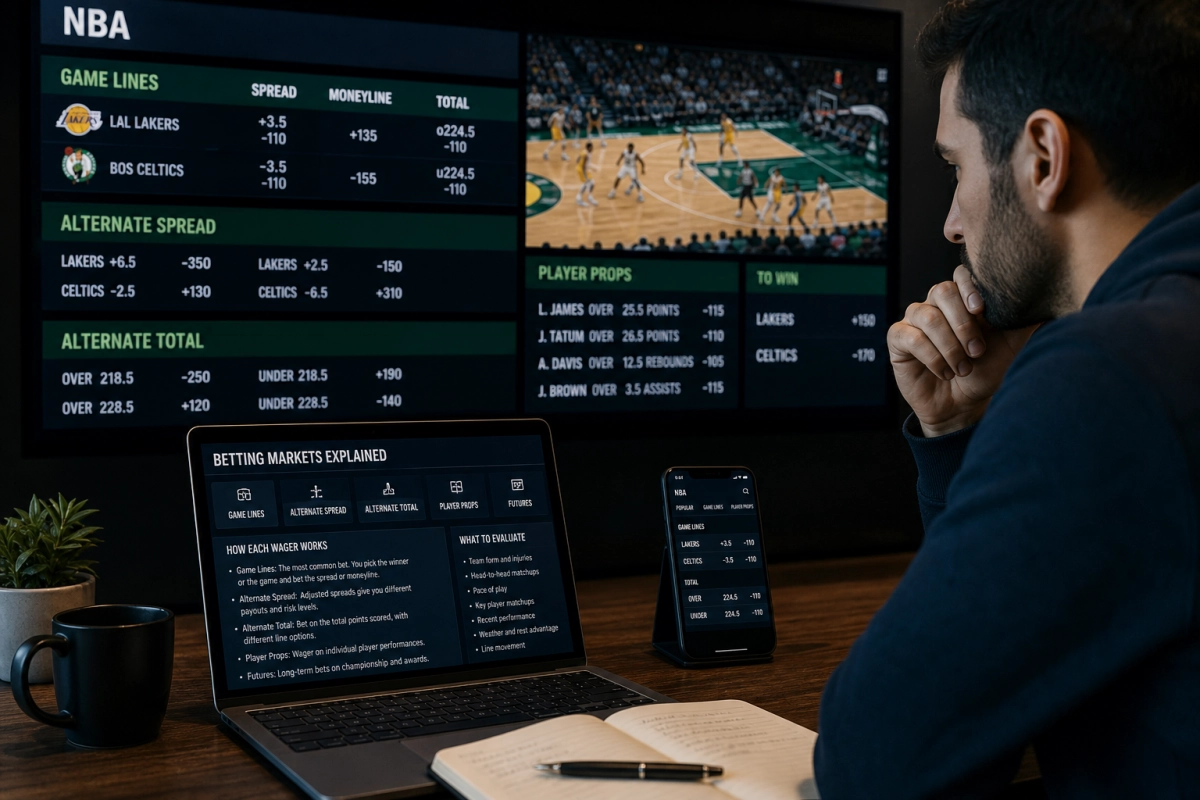
Why Understanding NBA Betting Markets Matters Before You Wager
The NBA is one of the most heavily traded sports betting markets in the world. Games tip off nearly every night across a long regular season, odds shift quickly in response to injury news and line movement, and sportsbooks offer dozens of markets per game. That volume is both an opportunity and a challenge.
The challenge is not finding markets to bet on. It is understanding how each market is structured, what the odds actually represent, and what factors are worth examining before committing to a wager. Bettors who skip that foundation tend to react to surface-level information rather than evaluate games with real depth. This guide builds that foundation, market by market.
The Three Core Markets Every NBA Bettor Should Know
Before exploring more specialised options, it helps to understand the three markets that form the backbone of NBA betting activity. Each works differently, carries its own risk profile, and rewards different types of analysis.
Moneyline Betting: Picking the Winner Outright
The moneyline is the simplest market available. A bettor picks which team wins, and the odds reflect how likely each outcome is considered to be. A heavy favourite carries lower returns because the implied probability of winning is high. An underdog offers greater potential returns to reflect the additional risk.
In NBA betting, moneyline odds are typically presented in American format. A line of -180 on the favourite means a bettor wagers 180 units to return 100 in profit. A line of +155 on the underdog means a 100-unit wager returns 155 in profit. The sportsbook builds its margin into the gap between those numbers, which is why implied probabilities across both sides always exceed 100 percent combined.
What makes moneyline betting more nuanced than it first appears is the question of value. Betting a heavy favourite at -250 or worse requires that team to win far more often than it loses just to return a profit over time. Experienced bettors weigh moneyline positions carefully on matchups where the line feels inflated by public perception rather than actual performance data.
Point Spread Betting: Levelling the Playing Field
Because many NBA games feature a clear favourite, sportsbooks introduce a point spread to create a more competitive wagering proposition. The favourite must win by more than the spread for that bet to pay out. The underdog can lose outright and still cover, as long as the final margin falls within the spread.
If a team is listed as a 7.5-point favourite, they need to win by eight or more for a spread bet on them to succeed. A bettor backing the underdog wins if that team either wins outright or loses by seven or fewer. The half-point eliminates the possibility of an exact tie on the spread, which would result in stakes being returned.
Spread betting demands more contextual analysis than a simple win-loss prediction. A team resting key players in a back-to-back game might still win comfortably but fail to cover a large spread. Rotation depth, pace of play, and recent margin of victory across different opponent levels all become relevant when evaluating spread positions.
Totals Betting and What Drives the Over/Under Line
The totals market asks bettors to predict whether the combined score will finish above or below a number set by the sportsbook. It removes the question of who wins entirely, focusing attention on the scoring environment of the game.
Sportsbooks set the total by assessing both teams’ offensive and defensive tendencies, pace of play, rest schedules, and recent scoring patterns. A matchup between two high-tempo offences with weak perimeter defence will typically carry a higher total than a game between defensive-minded teams that slow possessions.
- Pace rating: Teams ranked in the top tier for possessions per game tend to produce higher-scoring contests regardless of opponent.
- Defensive efficiency: A team allowing high points per possession raises the ceiling on any total it is involved in.
- Rest and fatigue: Teams on the second night of a back-to-back frequently show reduced defensive intensity, which can inflate scoring.
- Head-to-head scoring history: Some stylistic matchups consistently produce high or low totals regardless of season averages.
Quarter and Halftime Markets: Betting on Segments
Quarter and halftime markets let bettors isolate specific segments of a game, each carrying its own spread, moneyline, and total. These markets appeal to bettors who have identified tendencies more pronounced in certain game phases rather than across forty-eight minutes.
First-half betting is arguably the most popular segment market. Sportsbooks post a halftime spread and total reflecting starting lineup performance rather than full rotations. Because bench units feature more heavily in the second quarter, first-half lines can diverge meaningfully from a simple half-of-the-full-game calculation.
Quarter betting drills down further. The first quarter attracts particular attention because both coaching staffs tend to run primary lineups without significant rotation, making team tendencies easier to isolate.
- First-quarter scoring pace: Some teams consistently outscore opponents early before rotations disrupt rhythm.
- Halftime adjustment tendencies: Certain coaches are well-documented for strong halftime adjustments, which can suppress second-half scoring or swing momentum on the spread.
- Bench unit quality: Teams with shallow benches may hold early leads but fade when starters rest, affecting first-half spread outcomes.
Player Proposition Bets: Evaluating Individual Performance Markets
Player props have grown into one of the most active betting categories in the NBA. Rather than predicting a team outcome, these markets focus on individual statistical performance — points, rebounds, assists, three-pointers made, and combinations of those categories. A bettor picks whether a player will finish above or below a threshold set by the sportsbook.
Effective prop betting requires a layered approach. Opponent defensive matchups matter enormously — a wing scorer facing a team that ranks poorly at defending perimeter players is in a structurally better position than their season average alone would indicate. Minutes projections are equally critical. A player whose role fluctuates based on foul trouble or in-game score is far harder to project than one with a stable, defined role.
Key Variables Worth Examining Before Placing a Player Prop
- Defensive matchup rating: How does the opponent rank at defending the specific statistical category being bet on, using positional matchup data where available.
- Recent usage rate: A player’s share of team possessions over the last ten games can signal momentum in role that season-long averages obscure.
- Injury reports across both rosters: An absent teammate often elevates another player’s usage, while an injured opposing defender can open scoring lanes that would otherwise be closed.
- Home and away splits: Some players show significant statistical variation by venue, particularly in categories like three-point attempts.
- Game total context: A projected low-scoring game constrains counting stats across the board, making over bets less attractive regardless of matchup quality.
Live Betting Markets: Reading the Game as Odds Shift in Real Time
Live betting has reshaped how bettors engage with NBA games. Sportsbooks post continuously updated spreads, totals, and moneylines throughout the game, adjusting in real time based on scoring runs, foul trouble, pace changes, and momentum shifts. For bettors paying close attention to what is happening on the court, these markets can surface opportunities that pre-game lines never offered.
By the time a game reaches the second quarter, information that was uncertain before tip-off — foul trouble for a star player, an unexpectedly fast or slow pace, a team clearly disengaged defensively — is now visible. Bettors who process that information faster than the market adjusts can find edges structurally unavailable in pre-game wagering.
The challenge is that sportsbooks have become increasingly sophisticated at pricing live markets quickly. Lines move within seconds of significant plays, and windows for meaningful value are narrow. Live totals in particular deserve attention — a foul-heavy first half or heavy shot clock violations can compress scoring in ways the pre-game total did not account for, making real-time pace and defensive structure valuable reads.
Building a Consistent Approach Across Every Market
The NBA offers more betting markets per game than almost any other sport, and that volume invites a common mistake: spreading attention too thinly rather than developing genuine depth in markets that suit a bettor’s strengths and research habits.
A bettor who understands defensive matchup data deeply may find player props more productive than full-game spreads. Someone who tracks line movement and sharp betting signals closely may prefer pre-game totals where that information is most actionable. What matters is alignment between the information a bettor can realistically gather and the market they are attempting to evaluate.
Across every market discussed in this guide, a few principles hold consistently. Odds reflect perception as much as reality, and public perception is often shaped by recent results and narrative rather than careful analysis. Context changes the meaning of statistics — a player’s points average or a team’s record only matters when read against the specific conditions of the game being evaluated. And margin management is inseparable from market selection: a bettor who understands a market thoroughly but ignores the built-in sportsbook edge will still erode their bankroll over time.
NBA betting rewards preparation, selectivity, and an honest assessment of where your analytical edge actually lies. The markets are there in abundance. The discipline to engage with only the ones you understand well enough to evaluate properly is what separates structured wagering from guesswork dressed up in statistics.