
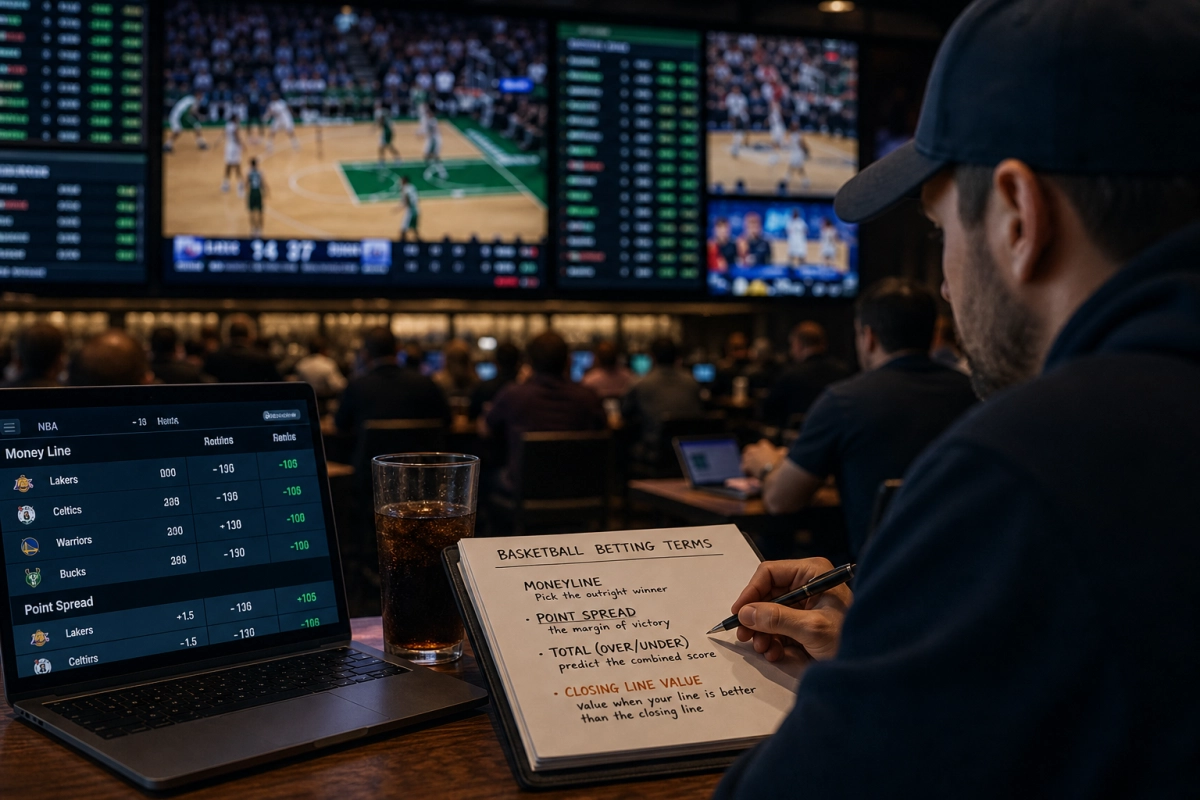
Why Basketball Betting Vocabulary Matters Before You Place a Wager
Walking into a sportsbook — or opening a betting app — without understanding the language is like reading a box score in a sport you’ve never watched. The numbers are visible, but the meaning is missing. Basketball betting terminology forms the foundation of every informed decision a bettor can make, and getting comfortable with the core vocabulary is the first practical step toward understanding how markets actually work.
This guide is built as a structured reference, not a dictionary. Each term is placed in context and connected to how it functions in real betting markets — whether that’s an NBA regular season game, a EuroLeague fixture, or a domestic league matchup. Beginners will find the basics laid out clearly; more experienced readers will find the advanced concepts explored with appropriate depth.
The Foundational Terms Every Basketball Bettor Should Understand
Most basketball betting markets are built around three core bet types. Understanding these is essential before moving toward anything more complex.
Moneyline
The moneyline is the most straightforward bet in basketball: you pick which team wins. There’s no margin involved. Odds are expressed differently depending on your sportsbook — American odds show a positive or negative number (such as -150 or +130), while decimal odds express the total return per unit staked. The favourite carries lower potential returns; the underdog pays out more. Because basketball rarely ends in a draw, moneyline markets are relatively clean for beginners to interpret.
Point Spread
The point spread, sometimes called the handicap, levels the playing field between unevenly matched teams. The favourite is assigned a negative spread — for example, -7.5 — meaning they must win by more than 7.5 points for a bet on them to pay out. The underdog receives the equivalent positive spread and can lose by up to 7 points and still cover. Spread betting is central to how basketball markets are structured, particularly in the NBA, because it creates a more competitive wagering environment around lopsided matchups.
Totals (Over/Under)
A totals bet asks whether the combined score of both teams will finish above or below a line set by the bookmaker. If the line is 224.5 and both teams combine for 231 points, the over wins. This market is influenced heavily by pace of play, defensive efficiency, and player availability — a late injury to a primary scorer can shift a total line noticeably. For bettors who prefer analysing team style over predicting outcomes, totals offer a distinct and often compelling angle.
Odds Formats and How Bookmakers Build Their Lines
Bookmakers don’t set odds purely based on probability — they build in a margin, often called the vig or juice, which ensures a theoretical profit regardless of which side wins. Decimal odds make this transparent. Odds of 1.90 on both sides imply a combined probability greater than 100%, with the excess representing the bookmaker’s edge. In American odds, if both sides of a spread are priced at -110, a bettor must wager $110 to win $100, with that gap funding the margin.
Related to this is implied probability — the percentage chance of an outcome that a given set of odds suggests. Converting odds to implied probability allows bettors to assess whether the market price reflects their own view of a game. An implied probability of 60% on a favourite means the bookmaker’s line suggests that team wins six times out of ten. Whether a bettor agrees or disagrees is where the analysis begins.
Line Movement, Live Odds, and What Shifts in the Market Actually Signal
A betting line is not a static number. From the moment a sportsbook opens a market — sometimes days before tip-off — the odds move in response to incoming wagers, injury reports, lineup news, and the behaviour of sharper bettors. Understanding why lines move is one of the more valuable skills a basketball bettor can develop, because the movement itself often carries more information than the original price.
When a line moves sharply without any obvious public trigger, it frequently signals that professional bettors — often called sharps — have placed significant action on one side. A spread that opens at -6 and moves to -8 within hours tells a story worth paying attention to. This connects to a concept known as a steam move — a rapid, coordinated shift triggered by sharp syndicate action across multiple books simultaneously. Recreational bettors who track line movement will sometimes spot steam moves and choose to follow them, though chasing sharp action carries its own risks if the context isn’t fully understood.
Opening Lines vs. Closing Lines
The opening line is the initial price a bookmaker publishes. The closing line is the final price before tip-off. The gap between the two reveals how the market digested new information. Closing line value — often abbreviated to CLV — matters particularly to bettors evaluating the long-term quality of their decisions. If a bettor consistently gets odds better than the closing line, it suggests they are identifying value before the broader market catches up. CLV is not a guarantee of profit on any individual bet, but across a large sample it functions as a meaningful indicator of betting quality.
Bet Types That Go Beyond the Basics
Parlays and Accumulators
A parlay combines two or more individual bets into a single wager, with each selection needing to win for the overall bet to pay out. The odds multiply across selections, creating the possibility of a significantly larger return from a smaller stake. The trade-off is equally clear — one incorrect selection voids the entire parlay. Sportsbooks tend to price parlays in a way that gives the house a larger inherent edge than individual bets, which is worth bearing in mind when assessing their value as a regular strategy.
Props and Player Markets
Proposition bets, commonly called props, focus on specific events within a game rather than overall outcomes. In basketball, this typically means player performance markets — whether a guard will record more or fewer than a set number of assists, whether a centre exceeds a rebound total, or whether a scorer hits a specific points threshold. Player props have grown significantly in availability, partly because they allow bettors to apply focused knowledge about matchups, usage rates, and defensive assignments. They also tend to attract less sharp action than main markets, which can occasionally create pricing inefficiencies worth exploring.
Alternative Lines and Teasers
Many sportsbooks offer alternative spreads and totals, allowing bettors to adjust the standard line in exchange for modified odds. Moving a spread from -7 to -4 in your favour costs you in payout but provides more margin for error. Teasers take this further — they allow bettors to shift multiple lines simultaneously across a parlay, typically by a fixed number of points, in exchange for reduced overall odds. Understanding how they’re structured is useful regardless of whether you choose to use them.
Sharper Concepts for Bettors Ready to Go Deeper
Reverse Line Movement
Reverse line movement occurs when a line moves in the opposite direction to where the majority of public betting tickets are going. If 70% of bets are on the favourite, logic suggests the spread should increase. When it moves the other way, it typically means sharp money is hitting the underdog hard enough to outweigh public volume. Reverse line movement is one of the more reliable signals that professional bettors are active on a specific side, and tracking it consistently adds useful context to line reading.
Juice and Line Shopping
The vig on any given market isn’t fixed. Different sportsbooks price the same game differently, sometimes by a meaningful margin. A spread bet priced at -110 at one book might be available at -105 elsewhere. Over hundreds of bets, that difference compounds into a significant sum. Line shopping — comparing odds across multiple sportsbooks before placing a bet — is one of the simplest and most underrated habits a bettor can build. Its long-term impact on returns is as real as any sharper strategic edge.
Expected Value
Expected value, often written as EV, sits at the heart of how serious bettors evaluate every wager. A positive expected value bet is one where the odds offered are generous relative to the actual likelihood of the outcome. A negative EV bet is the reverse. No individual bet is guaranteed to win simply because it carries positive expected value, but consistently identifying and placing positive EV wagers is the clearest framework available for sustainable, long-term performance in any betting market, including basketball.
Reading the Market Like a Language, Not a Lottery
Basketball betting terminology isn’t just jargon — it’s the operating language of a market that runs continuously across hundreds of games each season. Every term in this guide describes something that directly influences the price on your screen, the value embedded in a line, or the behaviour of the people setting and moving those numbers.
The bettor who understands what a closing line represents, why a steam move matters, and how implied probability connects to expected value is working with the same conceptual tools as the professionals shaping those markets. That doesn’t eliminate the inherent difficulty of betting well — the house edge is real, variance is relentless, and even strong processes produce losing runs. But vocabulary is leverage, and using it correctly shifts the activity from guesswork toward something far more considered.
Whether you return to this guide to clarify a specific term before a bet or work through it systematically to build your broader understanding, the goal is the same: to ensure that every wager you place is grounded in a clear reading of what the market is actually saying, rather than a reaction to a number that looks appealing on a screen.