

[Start HTML content here]
Start here: Why learning NBA betting odds changes how you approach games
You watch basketball for the action, but if you want to bet intelligently you need to understand the language bookmakers use: odds. Knowing how odds translate into probability and payout helps you spot value, size your bets correctly, and avoid common mistakes that turn small losses into bigger ones. In this part of the guide you’ll get a practical foundation — the basic bet types you’ll face, how American odds work, and why line movement matters.
What the odds tell you at a glance
Odds do three things at once: they indicate the bookmaker’s assessment of likely outcomes, they determine your payout, and they factor in the bookmaker’s profit margin (the “vig”). When you see a line, you should be able to read it and quickly know what a win will pay and how likely the market believes that outcome is. That skill is the first step toward finding bets that offer positive expected value.
Common NBA bet types you’ll encounter and how odds apply
Most sportsbooks present the same core bet types. Learn these and you’ll be able to understand every NBA market you come across.
- Moneyline — A straight win/lose wager. Odds are usually shown in American format (e.g., -150 or +200). Negative numbers show the favorite; positive show the underdog.
- Point spread — The favorite gives points, the underdog receives them (e.g., Lakers -6.5 means the Lakers must win by 7+ points). Payouts are typically near even money but can shift with public action.
- Totals (Over/Under) — You bet whether the combined score will be over or under a set number. This bet isolates pace and defense rather than who wins.
- Props and player markets — Focused on individual performances or specific game events (e.g., LeBron 25+ points). Lines can be inefficient and present opportunities if you’ve done homework.
- Futures and parlays — Long-term or multi-leg bets. They offer bigger payouts but require careful value assessment because variance increases.
Reading American odds and converting to implied probability
American odds are the most common in U.S. sportsbooks. To convert them into implied probability, use these quick rules: for positive odds (e.g., +200), probability = 100 / (odds + 100). For negative odds (e.g., -150), probability = odds / (odds + 100) using the absolute value. Converting shows you how the market perceives each outcome and lets you compare your own forecast to find value bets.
Understanding these basics — what each bet type measures, how payouts work, and how to read implied probability — gives you a reliable starting point. Next, you’ll learn how bookmakers set lines, how public money and sharps influence movement, and practical ways to exploit that information when you place your bets.
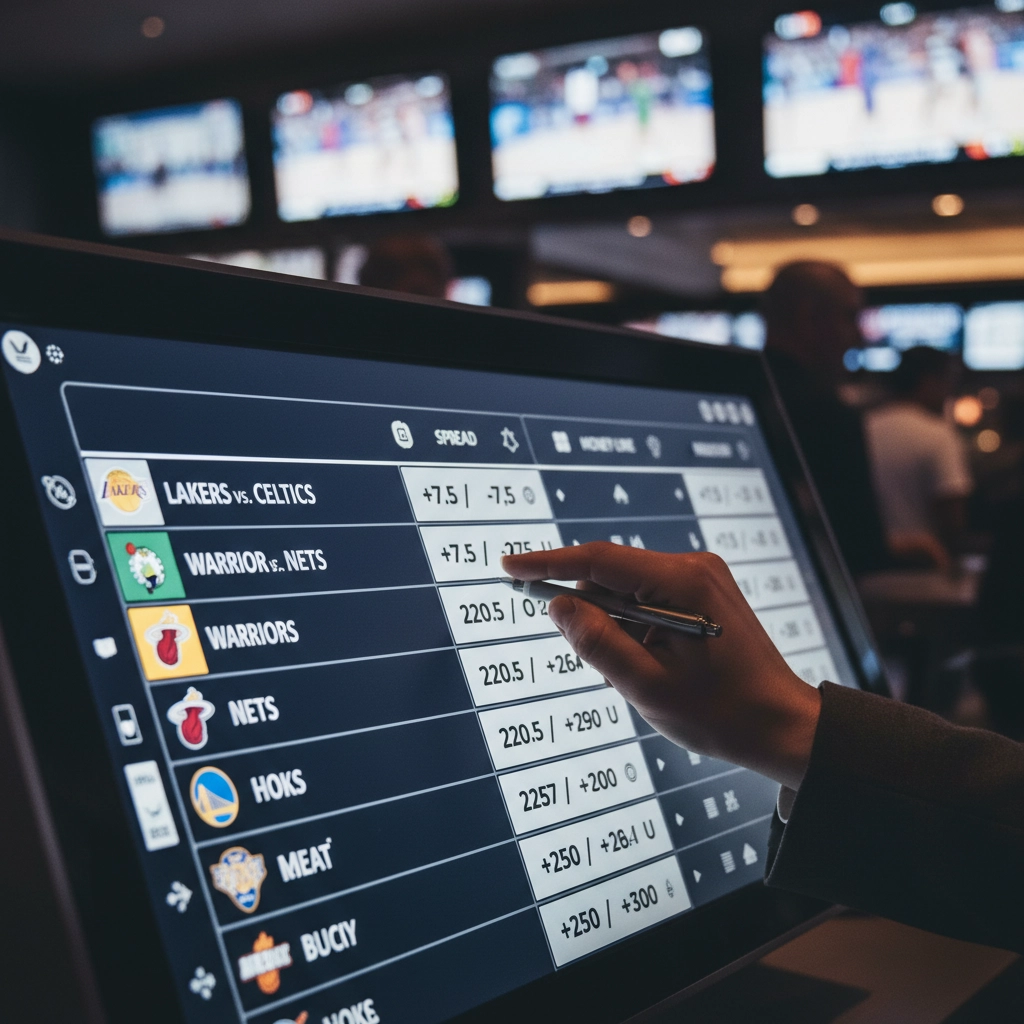
How sportsbooks set NBA lines — models, market-making, and the vig
Sportsbooks don’t pull numbers out of thin air. They start with power-rating models that combine team strength, pace, home-court advantage, rest, travel, injuries, and matchup factors. Those models produce an expected margin and total. Odds compilers then translate those projections into a moneyline, spread, and totals while factoring in how much they want to balance liability on each side.
Two practical points matter for bettors. First, opening lines reflect both quantitative forecasts and subjective adjustments: last-minute injury news, expected public bias, or a book’s specific clientele can nudge the initial price. Second, the bookmaker’s job is to balance action, not to predict perfectly — the vig (or juice) is baked into prices so the book earns a commission regardless of outcome distribution. That’s why implied probabilities from odds don’t sum to 100%: the excess is the bookmaker’s edge.
Limits and exposure management also shape lines. If a book is already heavy on a team or a sharp has been consistently profitable, the sportsbook may open smaller limits or shade the line to reduce risk. Understanding that books are market-makers rather than truth-tellers helps you read the purpose behind line shifts.
Reading line movement: public money, sharps, and what each tells you
Line movement is the market’s conversation. When a number shifts, it’s because money — or news — came in. But the source matters:
- Public money tends to be directional: favorites, popular teams, and overs when star scorers are playing. Heavy public action can move spreads and totals, sometimes creating value on the other side (a classic “fade the public” opportunity).
- Sharp money (professional bettors or syndicates) often comes in earlier, in larger units, and moves numbers quickly. Sharp-driven moves are usually smaller in magnitude but more predictive; following them can produce +EV outcomes.
Key signals to watch: the size of the line move, the timing (early vs. late in the market), and whether multiple books adjust in sync. A sudden, uniform shift across books (a “steam move”) often indicates sharp activity or new information the market trusts. Slow one-book movement with heavy public betting is more likely a nuisance move designed to balance liability.
How to use line movement and timing to find value
Turn the market’s signals into practical actions:
- Shop lines and maintain accounts at multiple books. The same line can differ by a half-point — that matters. Closing-line value (betting closer to where the line ends) is a proven predictor of long-term success; winning against the closing number usually correlates with positive ROI.
- Trade timing for information. Bet early on soft opening lines when you’ve identified an edge (thin markets, injury discount) or wait until sharp moves if you prefer following informed money. For props and limits, early action often gets better prices before books shorten limits or adjust on public trends.
- Look for middles and hedging opportunities. If a line moves from Lakers -3 to -7 and you’ve already taken Lakers -3, you’ve created a potential middle. Use correlated hedges (parlays, correlated props) carefully — they increase variance but can be profitable when the market is fragmented.
- Monitor public vs. money percentages. Some books publish both; if a high percentage of bets is on one side but the money is concentrated on the other, that’s a sharp signal worth considering.
Always size bets relative to conviction and bankroll. Market movement tells you why a line exists — your job is to decide whether the move reflects real information, noise, or exploitable mispricing.

Putting the guide into action
Betting smarter starts with disciplined habits: shop lines across books, size stakes to your bankroll and conviction, track your bets and closing-line value, and pay attention to timing and sharp activity rather than following headlines or hot streaks. Protect your long-term ability to play by using limits and by staying informed about injuries, rest, and matchup context. If you ever feel your gambling is becoming a problem, seek help — for example, see responsible gambling resources.
Frequently Asked Questions
How do I convert American odds to implied probability?
For positive odds (underdogs), use probability = 100 / (odds + 100). Example: +200 → 100 / (200 + 100) = 33.3%. For negative odds (favorites), use probability = |odds| / (|odds| + 100). Example: -150 → 150 / (150 + 100) = 60%.
When is it better to bet early versus waiting for line movement?
Bet early when you have an edge on soft opening lines, injury news not fully priced, or prop markets before limits shrink. Wait when you want to follow sharp money, verify late-breaking info, or capture better prices if the market is likely to move. The choice depends on your strategy, risk tolerance, and access to multiple books.
What is the sportsbook ‘vig’ and how does it affect my returns?
The vig (or juice) is the commission sportsbooks build into odds, so implied probabilities across outcomes sum to more than 100%. It reduces your payout relative to fair odds; minimizing its impact means shopping for the best price and targeting bets where you identify positive expected value above the vig.