Why mastering perimeter stops and paint protection wins games
In modern NBA defense, you can’t treat perimeter and paint defense as separate chores: they are two halves of the same job. As the defender, you must neutralize isolation scorers and shooters on the perimeter while ensuring the rim and short-area lanes remain protected. Teams that succeed do so by blending individual fundamentals with coordinated help principles. Understanding why both roles matter helps you prioritize practice time and in-game decision-making.
Perimeter defense controls possessions by limiting catch-and-shoot efficiency, disrupting ball handlers, and forcing turnovers. Paint protection prevents high-percentage finishes, controls defensive rebounding, and deters drives that collapse the defense. When you balance these responsibilities, you reduce easy points and create transition opportunities for your team.
Positioning, stance, and footwork every perimeter defender must own
Low, active stance and sightlines
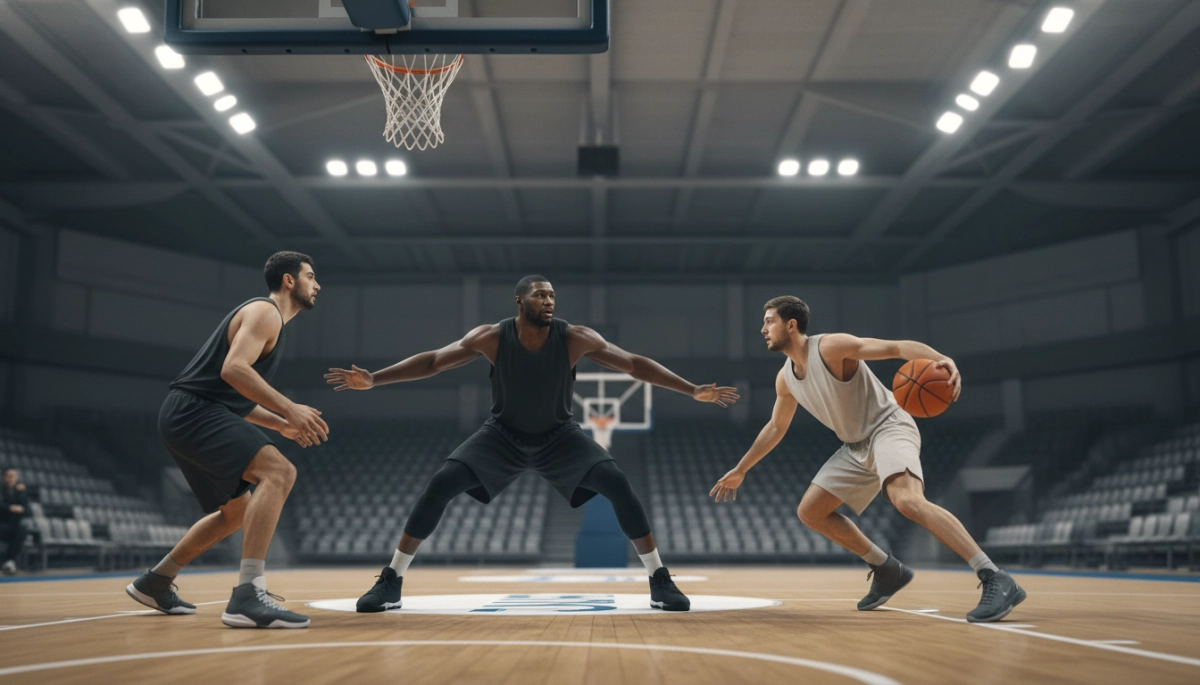
Your foundation is non-negotiable: a low, athletic stance with hips back and weight on the balls of your feet. This stance lets you mirror a ball-handler’s first step, contest shots without fouling, and recover to help rotations. Keep your head and chest facing the ball; line of sight matters more than where your feet point. If you lose sight of the ball or the offensive player’s hips, you increase the risk of being beat off the bounce.
Footwork patterns to stay in front
- Shuffle slides: prioritize lateral speed over crossing your feet; crossovers cost recovery time.
- Short choppy steps: when closing out to shooters, use small adjustments to avoid lunging and to stay balanced for a drive.
- Drop-step recovery: if beaten baseline, use a drop step to wedge the attacker and force a tougher angle to the rim.
- Change-of-direction reads: practice reading hips and shoulders to anticipate attacks rather than reacting to the ball.
Closeouts that force decisions
A proper closeout balances contesting the shot and preventing the drive. You should sprint from distance with hands high, then chop your feet as you approach to lower your center of gravity. Work to force the ball-handler toward help or the baseline instead of allowing a straight-line path to the rim.
Foundational paint protection and coordinated help-side principles
Help angles and rim protection priorities
Paint defense is not only about the rim protector; it’s about how you take away angles. When you help, aim to cut off the most direct line to the rim while keeping vision on your assigned player. Good help angles shrink the driving lane and present tougher finishing angles for the offensive player.
Box-out and rebounding responsibility
- Find your box-out immediately on a shot; even a strong perimeter defender must rebound to close the possession.
- Understand when to stay with your man versus when to concede a lesser scoring threat to secure the rebound and prevent second-chance points.
These fundamentals set the defensive baseline. Next, you’ll learn how to apply them in team schemes: rotations, switching rules, trap triggers, and read-and-react sequences that turn individual technique into a cohesive perimeter-and-paint stopping system.
Rotations and communication: timing the help-and-recover chain
Rotations win possessions. The moment the ball moves and a defender leaves his man to help, a precise chain of reads and verbal cues must activate. Start with a clear hierarchy: “I got ball” or “Ball” from the on-ball defender; “Help” or “Zip” from the first helper when he steps off his man; and “Recover” when the original defender is back in position. These simple calls keep the defense synchronized and prevent two defenders chasing one threat while others drift.
Timing is everything. Helpers should take one aggressive, decisive step to cut off the driving lane—then immediately locate their man with a quick shoulder/eye check. The on-ball defender must sprint to re-closeout, using short choppy steps to avoid lunging. If the rotation will cross a teammate’s lane, communicate the handoff: “Switch” or “Slip” so responsibility never blurs.
- Rule of thumb: commit the first help to stop the immediate threat; the next defender in line must be ready to cover the vacated assignment.
- Gap pursuit: when a helper leaves a gap, the weak-side perimeter defender slides to shrink it rather than over-rotating toward the rim.
- Late rotations are worse than early ones—better to rotate one beat early and contest than to scramble and allow a clean basket.
Switching rules and mismatch management
Switching neutralizes ball screens but creates mismatches. Have pre-set switching rules so players know when to switch, when to fight through, and when to hedge. Common models include: switch everything on pick-and-rolls under a certain distance from the rim, switch only against isolation-heavy guards, or switch only when the screener is a perimeter threat.
When a switch creates a mismatch, reduce damage with simple, repeatable tactics:
- Body-up defense: the smaller defender uses physicality to deny deep post position; front the post if the help can contain baseline cuts.
- Ice/squeeze to the sideline: force the ball-handler away from his preferred angle and toward the sideline where you can trap or rotate.
- Attack the mismatch elsewhere: run quick ball reversal or a dribble handoff to exploit the offensive mismatch on the opposite side.
Train defenders to identify mismatches in one glance and execute a single corrective action—deny entry, bring a strong-side help, or switch back on the next screen. Consistent rules reduce hesitation and foul trouble.
Trap triggers and pick-and-roll read-and-react sequences
Traps and pick-and-roll coverage are where perimeter and paint duties collide. Know your trap triggers: trapped ball below the free-throw line, sideline or baseline anchoring the drive, or a ball-handler with poor weak-hand control. Traps should be aggressive, angled to push the ball away from the middle, and timed so the secondary defenders are already sliding to cover shooters.
Execute a successful trap sequence by assigning roles: first trapper shoulders the ball-handler to the sideline; second trapper covers the inside gap and stops the middle. Weak-side defenders rotate to the nearest shooter and prepare to recover for rebounds. If the offense counters with a pick-and-pop, defenders must have clear read-and-react rules—hedge hard and switch if the pop threat is a viable shooter, or drop and protect the rim if the pop is a poor shooter.
Practice scenarios: 2-on-2 sideline trap leading to quick swing; hedge-then-recover against a quick pick-and-roll; and drop coverage against a bigger roller. Drill the sequencing until every defender knows whether to step up, drop, or recover at the first sign of the offensive decision—this is what turns individual technique into a cohesive perimeter-and-paint stopper.
Practice progression: drills to build perimeter-and-paint cohesion
Warm-up and fundamentals (10–15 minutes)
Start each session with stance, shuffle, closeout, and drop-step repetitions. Keep them live—finish with a controlled finish at the rim so defenders practice contesting without fouling.
Shell and rotation sequencing (15–20 minutes)
- Shell drill with live closeouts: emphasis on communication and one-step help angles.
- Add a delayed skip pass to force weak-side rotations and rebounding focus.
Pick-and-roll and trap reads (15–20 minutes)
- Two-on-two sideline action: practice trap triggers, second trappers’ timing, and recovery lanes.
- Hedge-then-recover vs. drop coverage: alternate by personnel to train instincts.
Live situational scrimmage (20–30 minutes)
Run short possessions (5–8 seconds) from common in-game spots—baseline drive, wing catch-and-shoot, high pick-and-roll—forcing defenders to react with the team rules. Finish with rebounding and outlet decisions.
Putting the system into action
Turn concepts into culture: set measurable defensive goals (opponent points in the paint, contested three-point rate, turnover creation), review film with specific correction points, and hold consistent practice repetitions. Emphasize clear, simple rules so players can react without hesitation. Trust the process—defensive excellence is built by repetition, accountability, and communication, not by complexity.
For coaches looking for additional session plans and resources, see the NBA Coach Development resources for drills and practice templates.