
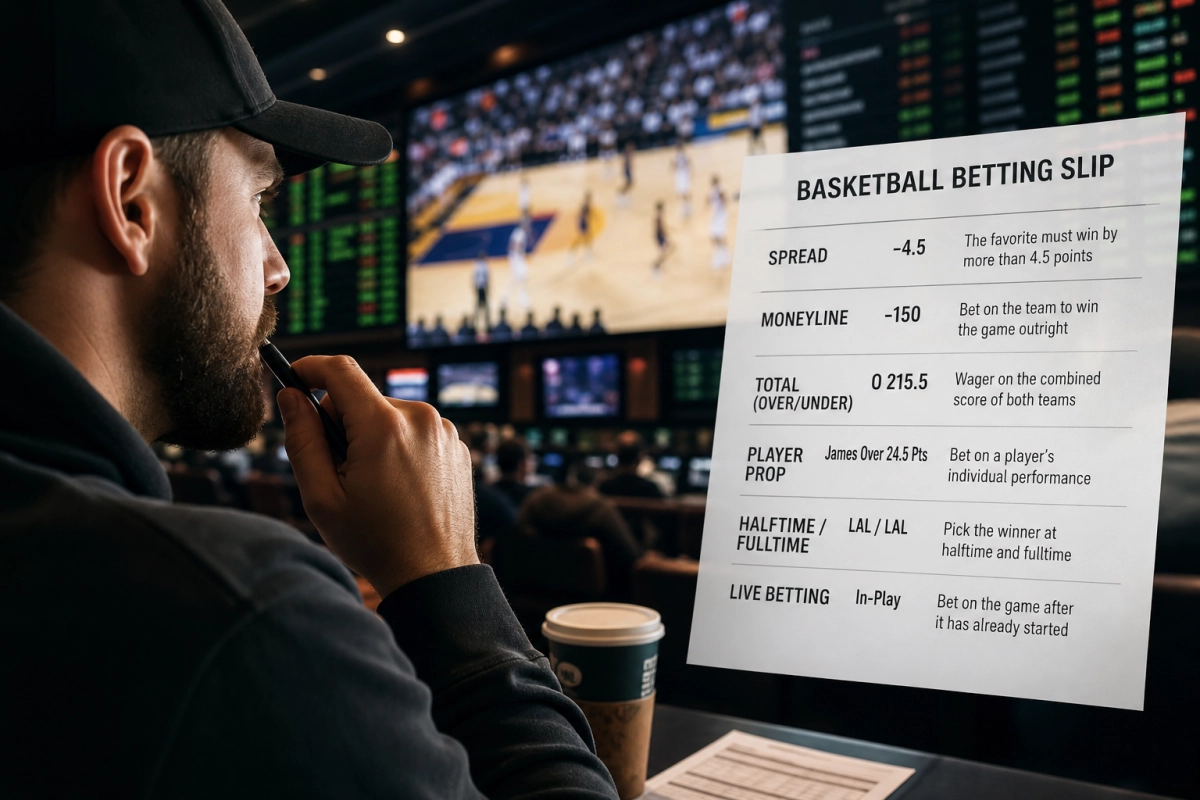
Why the Language of Basketball Betting Actually Matters
Most bettors learn basketball betting terminology the hard way — after a confusing result, a refunded stake, or a line that moved in the wrong direction without warning. The vocabulary of basketball betting is not decorative. Each term describes a mechanism that directly affects how much a bettor risks, what counts as a winning outcome, and whether a decision made hours before tip-off still holds value by game time.
A bettor who knows what juice means will approach a slip differently than one who simply sees a number. A bettor who understands what it means to cover a spread will read a final score differently, even when their team wins comfortably. This distinction shapes decisions at every stage — from reading an opening line to deciding whether to place a wager at all.
Juice, Cover, and Push: Three Terms That Change How You Read a Slip
Juice and the True Cost of Every Bet
Juice — also called the vig or vigorish — is the bookmaker’s built-in margin on every wager. It is why most spread and total bets are priced at -110 rather than even money. A bettor placing a standard spread wager must risk $110 to return $100 in profit. That extra $10 is the juice, collected regardless of which side wins.
To break even over time at -110, a bettor needs to win approximately 52.4% of wagers — not 50%. That threshold shifts further if juice increases. When a sportsbook adjusts one side of a spread from -110 to -115, the line number has not moved, but the cost of that position has risen quietly. A bettor who notices this is reading the market more accurately than one who only watches the spread itself.
Covering the Spread vs. Winning the Game
The point spread is one of the most commonly misread elements in basketball betting. A team can win convincingly and still fail to cover the spread. Equally, a team that loses outright can win the bet for those who backed them as underdogs.
Consider a practical example: a sportsbook lists Team A as a -7.5 favourite against Team B. Team A wins 108–102. The final margin is six points. Despite the victory, Team A has not covered — bettors who backed them against the spread have lost. Those who took Team B at +7.5 have won, because the underdog lost by fewer points than the spread required. Recognising this separation between match result and betting result is fundamental to reading any basketball slip correctly.
What a Push Means in Practice
A push occurs when the final margin lands exactly on the spread number. If Team A is -7 and wins by exactly seven points, no side wins or loses — all stakes are returned. Books set half-point spreads to eliminate this outcome, but whole-number lines remain common and pushes do occur. Bettors using parlays should note that a pushed leg typically removes that selection from the parlay rather than voiding the entire ticket, though this varies by sportsbook.
Juice, cover, and push interact constantly. Understanding each individually is useful, but seeing how they function together on a single slip changes the way a bettor evaluates every line they encounter.
Line Movement and What It Signals Before Tip-Off
Reading a Moving Line as Market Information
A betting line is not a fixed object. From the moment a sportsbook opens a game for wagering, the line can shift — sometimes by a half-point, sometimes by several — before tip-off. These movements reflect sharp money, public betting volume, and occasionally news such as injury updates or late roster changes.
When a line moves against public sentiment — most bets are on one side but the line moves toward that side — it often indicates that sharp, high-volume bettors have taken the opposite position. A bettor who opens a spread at -5.5 and watches it climb to -7 by game time has useful context: something has shifted the book’s confidence in that favourite beyond what the public alone would produce.
Timing a Bet Around Line Movement
Practical slip decisions often hinge on when a wager is placed, not just whether to place it. A bettor who identifies a team as strong value at -4.5 but delays may return to find the line at -6. That two-point shift represents a meaningfully different bet — one that now requires a more decisive performance from the favourite.
Betting early locks in a number before it moves against you but before full injury information is available. Betting late captures more information but risks reduced value. Understanding what line movement represents transforms this timing decision from guesswork into a considered strategic choice.
How These Terms Interact on a Single Parlay Slip
The Compounding Effect of Terminology Gaps
Where terminology confusion costs bettors most is on parlays, where multiple selections combine and the implications of each term compound. A three-leg parlay involving a spread, a total, and a moneyline carries its own juice, push scenarios, and line movement exposure across every leg.
If the total on one leg is set at a whole number — say 218 — and the game lands precisely there, the leg pushes. Depending on the sportsbook’s rules, that leg is removed and the parlay recalculates at reduced odds, or settled as if the selection never existed. A bettor who understood the push concept on a standalone bet but never considered it within a parlay will be caught off guard by a payout that does not match their original calculation.
Adjusting Stake Decisions Based on Juice Awareness
Juice affects parlay construction in a less obvious but equally important way. Each leg includes its own margin, and those margins stack. When a book prices individual legs at -115 instead of -110, the combined effect across multiple legs is more significant than the per-leg difference suggests.
- A single leg at -115 instead of -110 raises the break-even win rate modestly on its own.
- Across three parlay legs, that difference accumulates into a meaningful reduction in expected return.
- Line shopping — comparing juice across multiple books before placing — addresses this directly and costs nothing beyond the time taken to compare.
The ability to see a slip as a structure where juice, push rules, line movement, and cover thresholds all interact simultaneously is what separates a bettor who understands basketball betting terminology from one who has simply memorised its definitions.
Terminology Is the Lens, Not the Answer
Knowing what juice, cover, push, and line movement mean does not guarantee profitable outcomes. Basketball is unpredictable, and no vocabulary set changes that. What terminology does is remove a layer of avoidable confusion from decisions that are already difficult enough. A bettor who misreads a push as a loss, or mistakes a team winning the game for automatically covering the spread, is losing ground before the game has even been analysed on its merits.
The practical value becomes most visible in the moments between identifying a bet and placing it. Does the juice make the value thinner than it initially appeared? Has the line moved in a direction that suggests sharper money disagrees? If this is a parlay, what happens if one leg lands exactly on the number? These are not advanced questions — they are the basic structural questions every bet deserves, and they are only answerable by a bettor who has internalised the language well enough to apply it under time pressure.
The gap between bettors who find basketball wagering consistently frustrating and those who approach it with genuine composure rarely comes down to access to information or quality of analysis. It comes down to whether the bettor is reading the slip in the same language the market is written in. Juice, cover, push, and line movement are that language. Learning to read them fluently does not simplify basketball betting — the game remains as unpredictable as ever — but it does mean that every decision made is built on an accurate understanding of what is actually being wagered, at what cost, and under what conditions the bet wins.
That accuracy, applied consistently at the slip level, is where the difference compounds over time.