
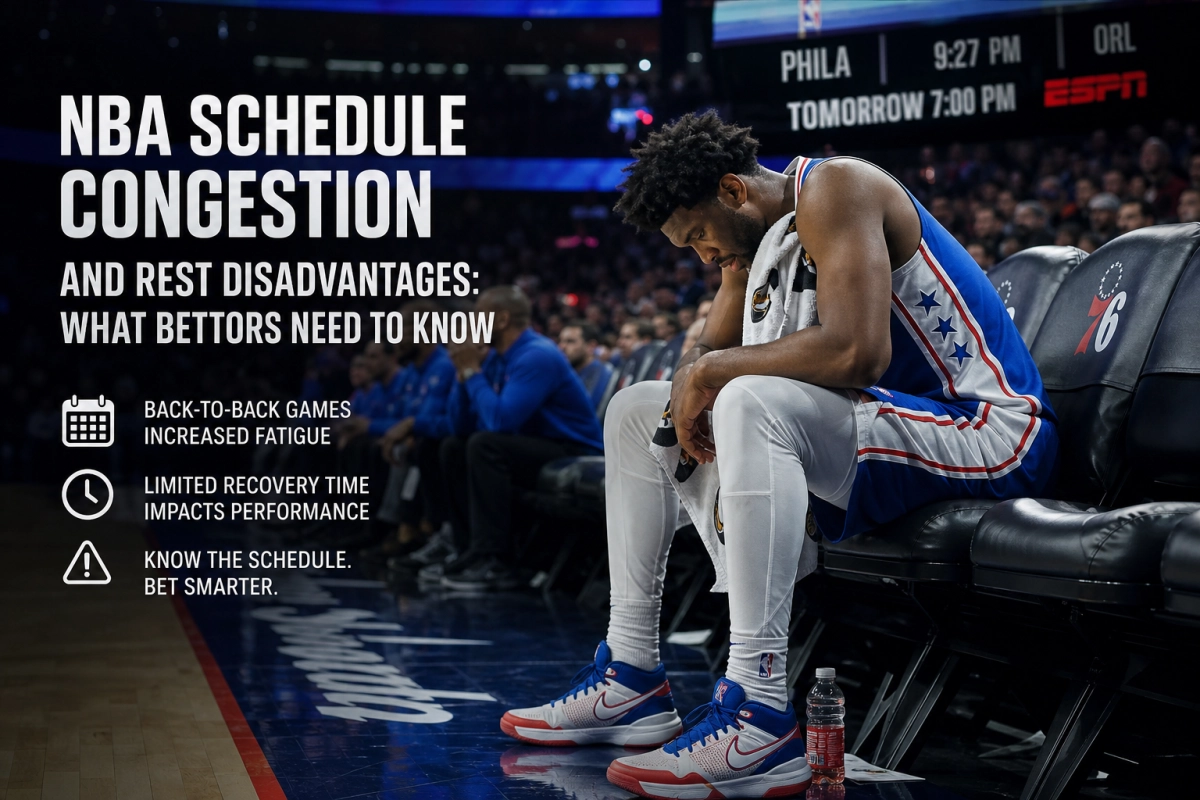
Why the NBA Schedule Creates Betting Opportunities That Many Readers Overlook
The NBA regular season is one of the most gruelling schedules in professional sport. Eighty-two games across roughly six months means teams are frequently on the road, playing on consecutive nights, and managing fatigue in ways that directly affect performance. For anyone engaged in NBA betting, understanding how scheduling pressures translate into market movement is not a bonus skill — it is fundamental to reading games accurately.
Sportsbooks factor rest and travel into their opening lines, but they do not always get the weighting right. Oddsmakers work with the same publicly available schedule data as everyone else, which means when the market misjudges the true impact of fatigue on a specific team, the point spread or total may not fully reflect what is likely to happen on the court.
What Back-to-Back Games and Schedule Congestion Actually Do to Teams
A back-to-back occurs when a team plays on two consecutive calendar days. Most teams play between 15 and 20 back-to-back sets across a full regular season. The second night is where performance effects are most visible. Players carry accumulated muscle fatigue, sleep is disrupted by travel, and coaching staff manage minutes carefully to protect key players from injury.
The effects are measurable. Teams on the second night of a back-to-back tend to show:
- Reduced defensive intensity, particularly in the third quarter when fatigue compounds
- Lower shot quality late in games as offensive execution breaks down
- Increased reliance on isolation plays rather than energy-intensive structured offences
- Higher foul rates among starters moved through earlier rotations
Schedule congestion goes beyond individual back-to-backs. A team playing five games in seven days across multiple time zones faces a different physiological challenge than one with two rest days between every game. Travel distance, flight schedules, and time zone changes all compound the fatigue factor. A West Coast team flying into the Eastern time zone for a 7:30 pm tipoff is effectively playing on internal-clock time that feels hours earlier — which sounds minor until you consider that performance margins at this level are already razor-thin.
The Rest Disadvantage: When One Team Has More Recovery Time
Perhaps the most direct scheduling variable in NBA betting is the rest disadvantage — situations where one team has had significantly more recovery time than the other. A well-rested team hosting a squad on the second night of a back-to-back holds a structural edge that has nothing to do with talent or form. Home court amplifies this further, since the visiting team has also absorbed the stress of travel.
Oddsmakers do adjust for rest discrepancies, but the adjustment is rarely uniform. The size of line movement depends on the teams involved, the perceived importance of the game, and public betting tendencies. A high-profile team on the second night of a back-to-back often attracts heavy recreational action regardless of fatigue, pushing the line in a direction that does not accurately reflect competitive reality.
How Sportsbooks Price Rest Differentials Into Opening Lines
Sharp oddsmakers maintain detailed internal models accounting for schedule density, travel miles, time zone crossings, and days of rest for every team. The rest differential component typically adjusts the spread by a point or two in straightforward back-to-back situations, but actual market movement can diverge significantly based on compounding variables.
The first is roster depth. A team with a genuine nine or ten-man rotation absorbs back-to-back fatigue differently than a squad built around two or three high-usage stars who cannot reasonably sit extended minutes. When a star-dependent team is on the second night of a back-to-back, performance risk concentrates in a way that deeper teams avoid. Bettors who apply a blanket rest-disadvantage discount to every fatigued team are working with a blunt instrument.
The second variable is opponent quality. A fatigued team playing a lottery-bound side presents a different proposition than the same fatigued team matched against a playoff contender in a standings-critical game. High-stakes opponents expose tired legs and slowed rotations more aggressively. Lines do not always capture this intensity differential with sufficient precision.
Totals and the Fatigue Factor: Where the Real Edge Often Lives
While most casual bettors focus on the point spread, the totals market frequently offers cleaner value in back-to-back and rest-disadvantage scenarios. Fatigue affects pace, shot quality, and defensive engagement in ways that are often more predictable than the final margin between two teams.
Consider what typically happens to scoring patterns on the second night of a back-to-back:
- Transition defence slows as tired legs fail to track back, inflating early-possession scores against the fatigued team
- Half-court offensive execution degrades, reducing scoring efficiency in late-clock situations
- Bench units play larger roles, creating scoring volatility that pushes totals in unpredictable directions
- Free throw rates shift as starters in foul trouble sit earlier, altering fourth-quarter scoring rhythm
The net effect on the total is not always a simple over or under lean. Totals set around the league average can represent genuine value on the over when the rested team runs a high-tempo, transition-oriented offence that feasts precisely when opponents lack the energy to get back.
The Role of Coaching Decisions in Amplifying Schedule Effects
Oddsmakers build lines based on statistical averages and historical patterns, but they cannot fully anticipate every coaching decision made in response to schedule pressure. These adjustments can shift the competitive landscape in ways that make a posted line look stale before the opening tip.
Load management — the deliberate resting of key players — has become increasingly sophisticated. When a star is listed as questionable on a back-to-back road game, the line adjustment after a confirmed absence can be dramatic. Bettors who anticipate these absences before the market reacts hold a meaningful timing advantage, particularly on games where news breaks close to tipoff.
Beyond outright rests, coaches frequently implement softer minute management that never appears on the injury report but is entirely predictable from context. A superstar who played 38 minutes the previous night is unlikely to repeat that load on consecutive evenings. If the posted line assumed normal usage and he plays 28 minutes instead, the market was mispriced before the ball went up. Recognising when these decisions are most likely — late in the regular season, during heavy travel stretches, when playoff seeding is secured — separates informed betting from reactive gambling.
Turning Schedule Awareness Into a Consistent Betting Edge
The NBA schedule is public information. Every back-to-back, every cross-country flight, every compressed stretch is visible to bettors and oddsmakers alike. What separates profitable schedule-aware betting from surface-level analysis is knowing which situations carry genuine market inefficiency and which have already been priced accurately enough to remove any exploitable edge.
A few principles tend to hold across seasons. First, the totals market is frequently softer than the spread when fatigue is the primary variable. Oddsmakers are more confident adjusting point spreads for rest differentials than modelling the precise scoring implications of reduced defensive intensity and degraded half-court execution. Bettors focused on totals are often fishing in less crowded water.
Second, timing matters enormously. Injury and rest confirmations for back-to-back games often arrive within hours of tipoff. Bettors who have already identified which games carry the highest load-management probability — based on schedule density, playoff positioning, and recent player minutes — can move faster than the broader market when news breaks.
Third, context always overrides formula. Not every team on a back-to-back is equally compromised, and not every rest advantage translates into an edge worth acting on. The quality of the opponent, the stakes of the game, rotation depth, and the specific players involved all shape how much the scheduling factor actually matters on a given night.
What schedule congestion analysis ultimately provides is a sharper filter for identifying which games carry structural mispricing worth acting on. Most games do not. The ones that do tend to share a common characteristic — the fatigue or rest variable is real, measurable, and not yet fully absorbed by the market. Finding those moments consistently, rather than chasing every back-to-back on the board, is where the long-term edge actually lives.
The NBA schedule is relentless by design. For the teams enduring it, that relentlessness is an occupational reality. For bettors who understand it properly, it remains one of the most reliable and underappreciated sources of genuine market value across an entire season.