
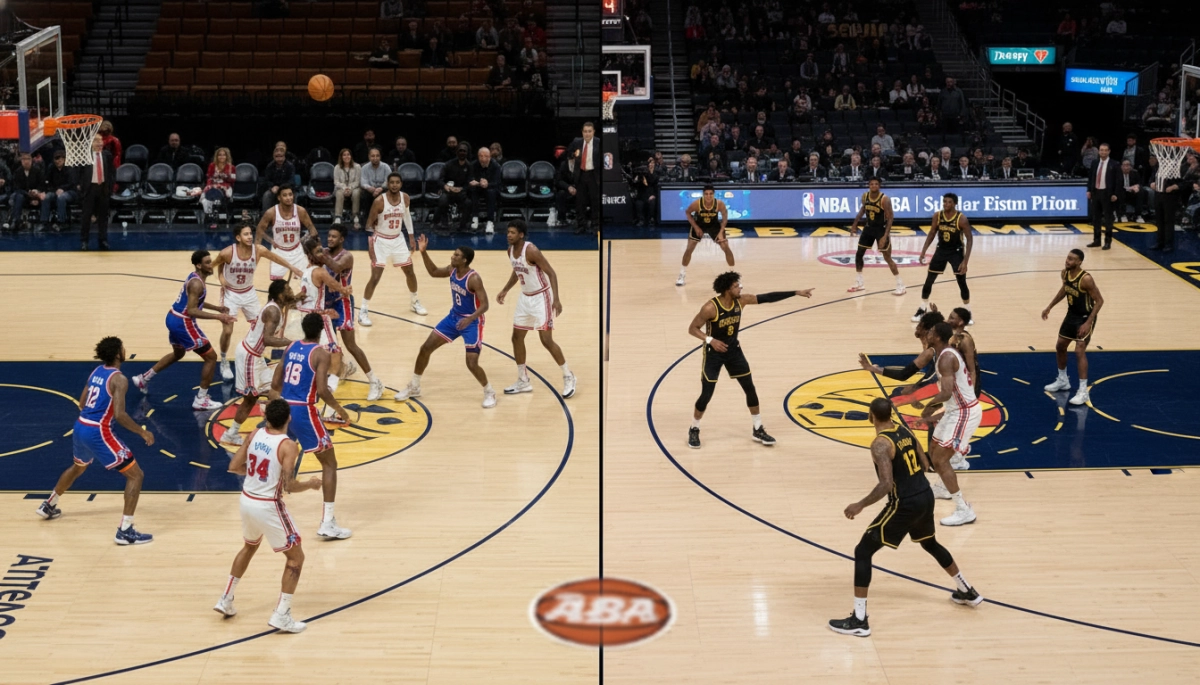
Why ABA and NBA offensive philosophies created different on-court rhythms
You study offenses to understand how rules, court features, and culture shape what you see during a game. The American Basketball Association (ABA) and the National Basketball Association (NBA) developed roughly parallel professional basketball traditions in the same era, but their offensive DNA diverged in ways that still matter when you analyze tempo, spacing, and play design.
Start by thinking in terms of incentives: what the league rewarded and how coaches adapted. The ABA embraced innovation—most famously the three-point shot—and a marketing-driven preference for high-scoring, fast-paced play. The NBA, for decades, favored half-court structure, post play, and incremental strategic evolution. Those different incentives changed how coaches pushed pace, how players used space, and what plays were diagrammed on coaching boards.
How tempo and pace were shaped by rules and culture
Faster pace in the ABA: design and consequence
In the ABA you felt the push to push the ball. The three-point line made quick transition possessions exponentially more valuable; a fast break that might have been a two-point layup in another league became a potential three-point swing. If you were coaching in the ABA, you were more likely to encourage early offense, frequent shot attempts, and aggressive rebounding for second-chance transition opportunities. Teams prioritized conditioning, quick outlet passes, and spacing that allowed immediate drives or pull-up jumpers from deep.
NBA tempo: methodical and possession-oriented
By contrast, the NBA rewarded possession control and structured sets. Without an early, universally adopted long-range scoring incentive, coaches emphasized half-court entries, post touches, and clock management—especially before the shot clock tightened to today’s standards. You see fewer frantic outlets and more deliberate sequencing: ball reversal, cutters, and set screens arranged to free scorers on the perimeter or create mismatches in the paint.
Spacing and scoring incentives: how the three-point line and player types changed alignment
Different spacing philosophies
Spacing is a direct response to how many points a shot is worth and who takes it. In the ABA, the three-pointer stretched defenses by default. You had perimeter-oriented lineups that spaced the floor to open lanes for drives or to generate catch-and-shoot attempts. That spacing encouraged quicker decision-making and off-ball movement because the defense had to respect distance shooters.
Roster construction and positional roles
In the NBA, earlier rosters were more frontcourt-heavy: big men who operated on the block, guards who distributed. With the center as a focal point, spacing was often compressed—wings hugged the paint and defenses could pack the lane. You had to design plays that freed a big man inside or used screens to create post-entry advantages. The absence (or limited use) of the three-pointer meant spacing served a different tactical purpose: carving attacking angles for interior scoring rather than stretching defenses horizontally.
These tempo and spacing contrasts set the stage for divergent play-design philosophies—how reads were structured, which sets dominated, and how coaches integrated off-ball movement. In the next section, you’ll examine specific play designs and diagrams that exemplify ABA versus NBA thinking, and how those templates migrated into the modern game.
Play designs that showcase the ABA’s early-offense ethos
In the ABA you’ll see plays built to capitalize on the first look—simple, repeatable reads that convert transition or the first 8–12 seconds of the shot clock into high-value shots. Typical ABA sets start with an aggressive rebound outlet or a sideline quick-inbound to a ballhandler sprinting the lane. From there, spacing is often 4-out/1-in or outright 5-out: wings occupy the corners and high elbows to widen driving lanes, while the primary ballhandler reads single-coverage or help-commitments.
A common template: a quick rim-runner slips to the basket on an early handoff while a wing curls or fades to the corner for a three. If the defense collapses on the drive, the ball swings for a catch-and-shoot; if it stays home, the rim-runner finishes or gets a touch for a short jumper. The choreography is deliberately lightweight—fewer pre-set screens, more motion cues and on-the-fly decisions—because the ABA rewarded speed and taking the first good look. Coaches drew up simple flare or pindown actions specifically to free shooters for pull-up threes off a fast break or immediate half-court reset.
That emphasis made certain player archetypes valuable: slashing wings who could space and attack instantly, and quick-release shooters who thrived on catch-and-shoot opportunities. The design intention was clear: create quick, high-value shots before the defense could reset into a conservative, packed alignment.
NBA set plays: structure, reads, and the slow-burn construction
NBA play design historically favored multi-phase sets that can manufacture a scoring advantage even against disciplined coverages. Think horns or 1-4 high alignments where the point guard’s first pass triggers a sequence of screens, post entries, and internal spacing adjustments. These sets are predicated on reads—if the post defender helps, kick; if the screening action frees the big, hit the roll; if neither, recycle to a secondary action.
A representative play is a guard-to-post entry followed by two staggered off-ball screens aimed at generating a mid-range or paint advantage for a specific big man. Another staple is isolation-creation through ball screen spacing; the screen is angled to force a switch or draw a help defender, and wings are positioned to punish rotations. The play-caller builds contingency after contingency into the design—options to re-screen, slip, or reverse the ball—because the NBA historically tolerated fewer immediate breakdowns and rewarded sustained possession control.
How those templates migrated and merged into the modern playbook
Once the three-pointer and analytical thinking altered value calculus, the two approaches began to converge. ABA-style early shooting and spacing fused with NBA-style read-based sets: teams now diagram quick-hitting early offense within structured possession frameworks. Modern offenses often open possessions with a controlled transition set—5-out spacing to invite a drive or rim-run—then fold into a horns or spread pick-and-roll structure if the immediate look isn’t there.
The result is play design that values quick creation but still contains layered reads and counter-screens. Coaches borrow the ABA’s prioritization of spacing and quick kicks while retaining the NBA’s discipline around play sequencing and mismatch exploitation. The contemporary playbook is therefore less about league origin and more about synthesis: maximize shot value quickly, but have multiple engineered paths to get there when defenses adapt.
Practical implications for coaches and players
Understanding how tempo, spacing, and design interact gives coaches and players tools to adapt in-game and across a season. Preparation isn’t just about installing sets—it’s about rehearsing reads, conditioning for the chosen pace, and developing skill profiles that fit your preferred spacing.
- Coaches: teach repeatable early-offense reads and layer in secondary sets so a stalled transition can become a structured advantage.
- Players: develop shot selection discipline (value the three when it’s open, attack the closeouts when it’s not) and cultivate interchangeable skills—ballhandling, screening, and finishing—in different spacing schemes.
- Analysts: track possession-level outcomes (points per possession early vs. late, shooting splits by location) to quantify whether a faster or more methodical approach yields consistent gains against varied defenses.
The strategic horizon
Basketball’s offensive DNA will keep evolving—rules, analytics, and player skill sets continue to push and pull tempo and spacing in new directions. Rather than a binary ABA-vs-NBA split, expect a fluid marketplace of ideas where coaches mix early aggression with engineered possession frameworks, and teams tailor approaches to roster strengths and opponent tendencies. Watching the game with an eye for how a possession is engineered—what read is being forced, how spacing manipulates help, and when a team opts for immediate value versus long possession craft—reveals more than the final score; it shows the ongoing conversation between design and execution. For evolving league-level perspectives and coaching resources, see NBA.com.