
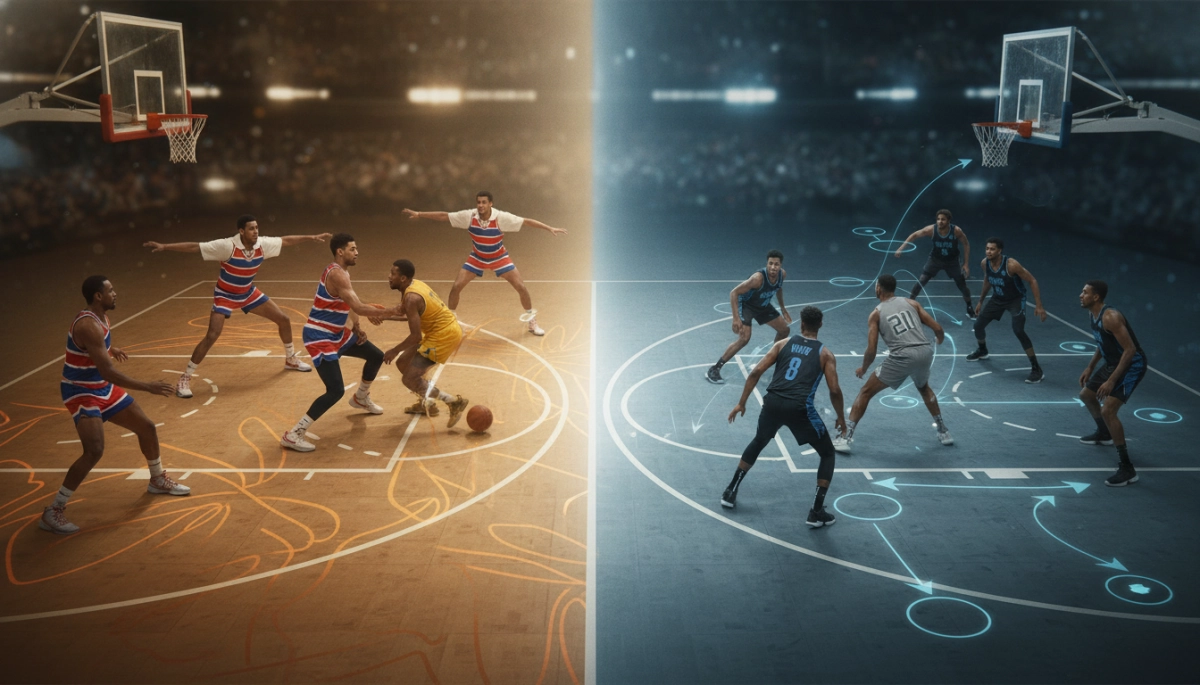
How league mechanics force different defensive priorities
When you compare ABA-era basketball with modern or historical NBA play, start by looking at what the rules and style reward. The ABA introduced the three-point line and encouraged a faster pace; that changes where you position defenders and how aggressively you gamble for steals. The NBA, depending on the era you study, can emphasize half-court sets, post play, and rim protection. Those differences shape whether you prioritize perimeter closeouts, help-side rim deterrence, or versatile switchability in your rotations.
Practically, this means you should ask: are you defending more possessions in transition or fewer, longer possessions? Do you need to prevent long-range shooting more than interior scoring? Your answers will determine whether matchups, zones, or pressing become primary tools.
Matchups: picking personnel and tactics for man-to-man defense
Man-to-man defense remains the baseline in both ABA and NBA contexts, but how you define your matchups will change. In an ABA-style environment — up-tempo with more three-point attempts — you’ll often assign quicker, switchable wings to perimeter shooters and prioritize lateral quickness over sheer size. You’re defending more possessions that begin in transition, so communication on early help and establishing matchup continuity matters.
- Switching thresholds: In a pace-heavy game, switch on off-ball screens more aggressively to avoid open threes; in NBA half-court sets, be selective and use drop coverage more often against skilled bigs.
- Handling pick-and-rolls: If the opponent runs smaller, faster lineups (ABA-style), hedge-and-recover or soft-showing becomes risky — you’ll favor quick switches. Against classic NBA backcourts with big roll-men, use drop coverage and rely on rim protectors.
- Matchup continuity: Make sure your primary ball-defender can handle early closeouts; secondary defenders should be prepared to “ice” or trap sideline actions depending on your opponent’s ball dominant tendencies.
Zones and presses: where spacing and tempo dictate adjustments
Zones react differently to the three-point emphasis of ABA-like play and the interior focus often found in NBA matchups. If opponents attack the perimeter constantly, a traditional 2-3 zone will invite open threes; you’ll instead prefer a 1-3-1 or a 3-2 that extends more to contest outside shots. In NBA contexts where teams probe the paint, 2-3 or 3-2 zones can clog driving lanes and conserve energy for late-game possession defense.
Pressing also diverges. The ABA’s higher tempo rewards full-court pressure to force turnovers and create transition offense; you should use periodic traps and rolling rotations to avoid getting beaten for layups. In the NBA, presses are more situational — used to stop momentum or exploit a weak ball-handler — and must be balanced with quick retreat strategies to protect the rim.
To prepare your unit, focus drills on closeout technique, situational rotations (trap-to-halfcourt recovery), and communicating who covers the weak-side corner when you extend to press. These early tactical choices set up whether you’ll lean on matchup rigidity, flexible switching, or zone variety — and they lead directly into how you adjust within a game, which we’ll explore next.
In-game adjustments: reading rhythm, personnel, and momentum
Once the game starts, pregame plans rarely survive intact. Successful defensive coaches and players make micro-adjustments by reading tempo, personnel substitutions, and where the offense is getting comfortable. The first priority is spotting trends within the first few possessions: are threes coming off ball-screens, catch-and-shoots from corners, or early-transition pull-ups? That diagnosis dictates whether you tighten closeouts, hedge harder, or extend your zone to the perimeter.
Practical rules to guide real-time choices:
- Trend window: Treat the first 6–10 offensive sets against you as a scout report. If a shooter heats up from a specific spot, switch matchups or force him into longer dribbles.
- Personnel counters: When the other team brings in a small, switch-heavy unit, shrink your drop coverage and play more physically on the line to prevent easy drives. Conversely, if they insert a big pick-and-roll duo, play more conservative with help and ice weak-side actions.
- Momentum plays: Use situational pressure (press, trap, or aggressive hand-checks) after an opponent string of easy baskets to disrupt rhythm — but have immediate recovery plans to avoid giving up quick layups.
Defending modern sets: pick-and-roll, pick-and-pop, and off-ball movement
Contemporary offenses blend spread pick-and-roll, pick-and-pop, and coordinated off-ball motion; defending them requires both scheme and technique. Instead of a one-size-fits-all reaction, assign specific answers for each base action and drill them until rotations become reflexive.
- Pick-and-roll vs. pick-and-pop: Pre-designate whether the screener is a roll or pop threat. If pop is primary, commit to harder hedges and switching to prevent open pull-ups; if roll is the threat, emphasize drop or rim-contest principles with rim protector ready to contest the finish.
- Stagger and horn screens: Use “ice” principles on side pick-and-rolls to funnel towards help-side baseline or exploit weaker ball-handlers with early double triggers.
- Off-ball movement: Assign responsibility for screening actions — who fights through, who fights over — and practice the last-pass denial. Physical, opportunistic closeouts on catch-and-shoot situations reduce threes without over-committing help.
- Late shot-clock defense: Simplify choices; favor conservative help that prevents layups and offensive rebounds over gambling for steals that risk wide-open threes.
Rotation management: substitutions, foul trouble, and minute allocation
How you rotate players across a game frequently determines whether an otherwise sound scheme succeeds. Balancing energy, matchup needs, and foul management is especially important when switching between press-heavy and half-court defensive modes.
Concrete rotation principles:
- Role continuity: Keep one defensive anchor (rim protector or primary on-ball defender) on the floor in each stretch to preserve communication and matchup stability.
- Staggering minutes: Avoid removing all your switchable wings or all your rim protectors at once; stagger substitutions so each lineup retains at least one specialist.
- Foul management: When a key defender picks up fouls, temporarily shrink your defensive scope (less pressing, more zone/drop) rather than forcing them into risky closeouts that compound the problem.
- Timeouts and short breaks: Use stoppages to reset defensive roles, especially after a scoring run, clarifying who picks up the hot shooter and whether to change coverage for the next series.
These operational choices — reading the game, assigning specific counters to common actions, and managing player availability— allow a defense to be adaptable without being chaotic. In Part 3 we’ll apply these concepts to endgame situations and how analytics refine those adjustments.
Endgame situations: late-possession priorities and foul management
In the final minutes and possessions, defensive choices narrow to a few high-leverage actions. Prioritize denying the ball to the opponent’s primary creator, protecting the rim on isolation attempts, and managing fouls to avoid gifting free points or removing key defenders.
- On the final possession: simplify responsibilities — identify the ball-handler, force baseline/weak-side trips, and eliminate secondary options with clear weak-side denial.
- Shot-clock scenarios: with 10–6 seconds left, drop or shade to prevent easy drives; with under 6 seconds, contest the catch-and-shoot aggressively while securing the defensive rebound lane.
- Foul strategy: if behind and fouling is required, choose matchups where your fouler is least likely to get into immediate foul trouble or to rotate into a critical defensive role the next possession.
- Timeouts and set plays: use timeouts to install a single, clearly defined defensive plan for the sequence ahead — confusion on late-possession assignments is costly.
Analytics and feedback loops: using data to sharpen defensive calls
Analytics shouldn’t replace instincts, but they focus practice and in-game choices. Track opponent shot maps, lineup matchups, and possession-level outcomes to decide whether to force switches, extend zones, or press selectively.
- Key metrics to watch: opponent PPP (points per possession) in different lineup matchups, opponent corner and catch-and-shoot three frequency, and defensive rebound rates after contested shots.
- Micro-adjustments from data: if an opposing guard posts a high pull-up PPP, harden on-ball pressure; if a lineup concedes corner threes at a high rate, extend your 3-2/1-3-1 perimeter coverage.
- Practice with purpose: simulate opponent tendencies in walk-throughs and constrain scrimmage scoring to replicate the scenarios analytics flag as most damaging.
- Tools and resources: integrate publicly available sources like NBA Advanced Stats into your prep to visualize shot distributions and lineup efficiencies.
Putting theory into practice
Defense is an evolving craft: the best units blend clear, repeatable techniques with adaptive decision-making informed by data. Build habits that make rotation choices automatic, use analytics to reduce guesswork, and cultivate a culture where communication and accountability determine whether strategy turns into stops. Ultimately, the toolbox—matchups, zones, presses, and analytics—only produces consistent results when players and coaches commit to drilling, reviewing, and iterating together.