
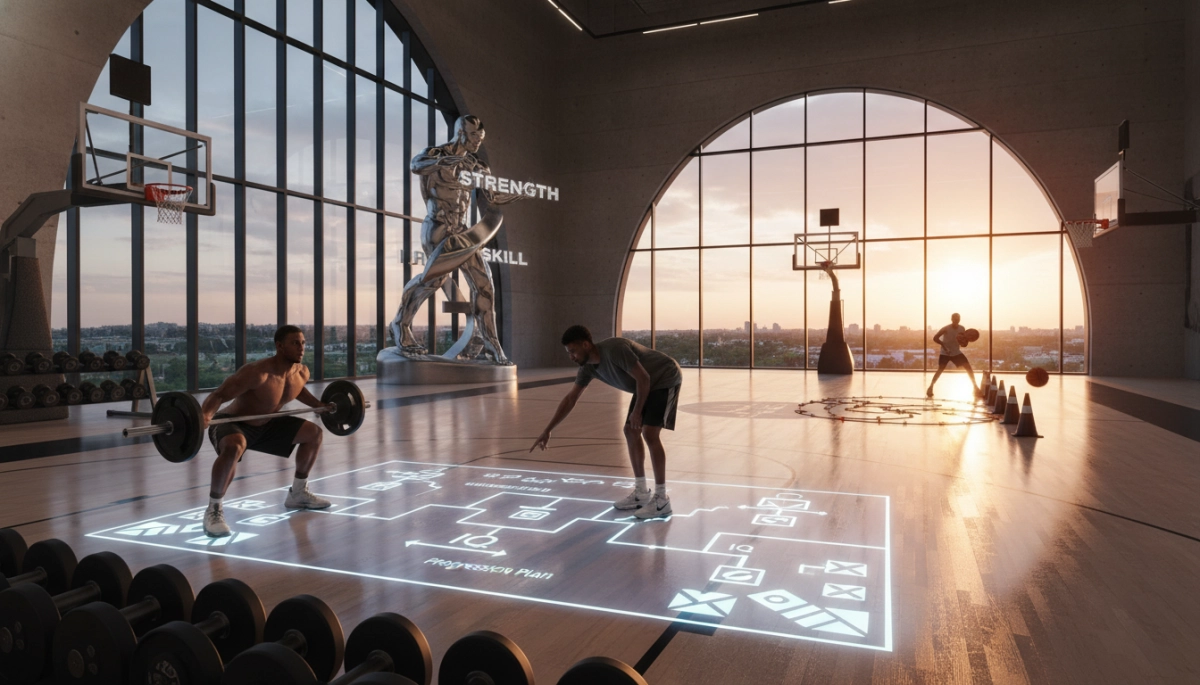
How NBA player development accelerates your on-court impact
You want to improve faster, and NBA player development does that by turning vague “work harder” advice into measurable, repeatable progress. In the league, development is a triad: physical strength and conditioning, basketball IQ (decision-making and situational awareness), and skill progression plans that break complex moves into daily tasks. When you understand how those pieces interact, you can design a season-long roadmap that maximizes minutes, minimizes injury risk, and targets the skills coaches value most.
Build a strength and conditioning foundation that transfers to game speed
Strength training in an NBA context isn’t just about lifting heavy — it’s about improving force production, stability, and repeatability under fatigue. You should prioritize multi-plane, sport-specific work that translates directly to sprinting, jumping, absorbing contact, and finishing at the rim. Core principles to follow include:
- Movement quality first: address mobility and foundational stability so strength gains transfer to skates and cuts.
- Progressive overload with specificity: increase resistance or complexity in ways that mimic basketball tasks (e.g., loaded step-ups, single-leg RDLs, resisted sprints).
- Power and rate-of-force development: include Olympic-derivative lifts, medicine ball throws, and jump training to raise your explosiveness for rebounding and drives.
- Energy system conditioning: perform high-intensity interval work that approximates 5–15 second sprint efforts between breaks to sustain performance over quarters.
- Recovery and durability: integrate soft-tissue work, sleep prioritization, and nutrition to maintain progress across a season.
Measure progress with objective metrics you can track weekly: vertical jump, 3/4 court sprint time, single-leg balance, and force-platform outputs when available. These data points help you and your coaches decide when to push or deload.
Develop your basketball IQ early so skill sessions become more productive
Basketball IQ is the way you process reads, timing, spacing, and opponent tendencies. You increase it by deliberate exposure to game-like situations and reflective practice. Focus on three learning channels:
- Film study with a purpose: watch possessions to understand spacing and decision trees rather than simply counting plays.
- Situational reps: simulate late-clock reads, pick-and-roll coverages, and transition defense in controlled scrimmages.
- Feedback loops: use coach-led cues and self-assessment to convert mistakes into repeatable corrections.
When you pair improved IQ with a consistent strength base, your skill work becomes more efficient: every drill you do carries higher transfer to live games because you understand when and how to use each move.
Next, you’ll break down specific skill progression plans—dribble, shooting, finishing, and defensive skill ladders—and learn how to schedule them into a weekly microcycle.
Skill ladders: concrete progressions for dribbling, shooting, finishing, and defense
Each core skill should have a ladder: a short sequence of increasingly game-like tasks that force you to solve progressively harder problems. Build ladders with three tiers — foundational, applied, and live — and specify reps, tempo, and success criteria for each rung.
– Dribble ladder
– Foundational: 3-ball stationary control, weak-hand figure-8s, 30–45 seconds each. Criteria: <3 losses per set.
– Applied: moving change-of-direction sequences (crossover to between-legs to step-back) at 70% speed for 6–8 reps each side. Criteria: maintain balance and line of flight on 80% of reps.
– Live: 1v1 attack from wing with defender closing out, finish or reset in 6 seconds; 8–12 reps. Criteria: create a shot or kick 60% of reps.
– Shooting ladder
– Foundational: form shooting (5–8 ft) 50 makes, catch-and-shoot spot work (5 spots × 10 shots), focus on repeatable mechanics.
– Applied: off-dribble pull-ups and pace shooting (two-step, sprint to catch) 6–8 reps per spot at 75% game speed.
– Live: game-sim threes and pull-ups against closeout or live closeout defender—set a makes/attempts target (e.g., 40%+ on threes, 45% on twos).
– Finishing ladder
– Foundational: finishing angles with contact pads (two-handed finishes, reverse layups), 8–10 reps each angle.
– Applied: pick-and-roll finishes with rim contact and floaters, emphasizing touch under fatigue; 10 reps each side.
– Live: contested rim attacks against drop/ICE coverage, use counter moves—8–12 reps, prioritize at least 50% high-quality attempts (shot, foul, or assist).
– Defensive ladder
– Foundational: stance and slide drills, mirror footwork, closeout control—3 × 30-second sets.
– Applied: shell with situational rotations (help-side, backside recoveries) against 3-on-3 for 6 minutes.
– Live: 1v1 and 2v2 competitive possessions focusing on on-ball discipline and communication; track stops per possessions.
Define progression rules: pass to next rung when success criteria met in 3 consecutive sessions; regress if success drops below threshold for two sessions.
Weekly microcycle: sequencing skills, strength work, and live reps for transfer
Structure your week so high-skill-quality sessions come when freshness is highest and live exposure is concentrated but controlled. Example microcycle for an in-season player:
– Monday — High-skill, low-contact
– Morning: skill session (shooting ladder foundational → applied), 45–60 min.
– Afternoon: light S&C (mobility, activation, low-load power).
– Tuesday — Strength + applied live work
– Morning: strength session (moderate load).
– Evening: applied skill + competitive 3v3 (emphasize finishing ladder), 60–75 min.
– Wednesday — Recovery + IQ work
– Film review (30–45 min), soft tissue, optional light shooting (maintenance).
– Thursday — High-intensity live reps
– Morning: high-intensity conditioning.
– Evening: full-speed 5v5 or simulated game snippets, target 12–20 “high-quality” live possessions.
– Friday — Skill retooling
– Morning: individual skill session (weak-point focus, technique under low fatigue).
– Afternoon: pre-game activation.
– Saturday — Game or scrimmage
– Manage load based on minutes; prioritize recovery after.
– Sunday — Active recovery
Rules of thumb:
– Place technical, high-focus skill work 48–72 hours after heavy strength for best motor learning.
– Limit full-speed live reps to avoid compounding contact fatigue; prioritize quality (reads, outcomes) over raw volume.
– Adjust S&C intensity based on minutes and travel. Use RPE and performance metrics (shooting %) to decide deloads.
Use objective markers (jump height, sprint time, shooting efficiency in applied drills, stops per 100 possessions on defense) to make weekly decisions. When a metric trends down across two sessions, reduce contact and reset to technique-focused work for 48–72 hours.
Monitoring progress and adjusting the plan
Track a small set of reliable metrics and use them to inform weekly tweaks rather than overhaul your approach after every session. Useful markers include jump height, sprint time, shooting efficiency in applied drills, training RPE, and a simple wellness score (sleep, soreness, mood). Establish decision rules—when two markers decline, switch to a 48–72 hour technique and recovery block. When metrics rise and confidence follows, add targeted overloads or more live reps.
- Weekly review: compare current metrics to a 4-week rolling average and flag meaningful changes.
- Communication: share trends with coaches and sport-science staff to align practice load with game demands.
- Individualization: prioritize what moves the needle for your role and minutes; not every player needs the same ladder emphasis.
Putting progressive development into action
Player development is a long, iterative process that rewards consistency, honest feedback, and smart risk management. Commit to small, measurable improvements each week, protect recovery so gains consolidate, and keep your learning active—use film, deliberate practice, and live reps with clear outcome goals. Stay curious about evidence-based methods and practical templates from established programs; for further reading, explore NBA Player Development resources. Above all, treat your plan as a living document: test, measure, and refine so your strength, IQ, and skills advance in lockstep toward meaningful game impact.
How NBA player development accelerates your on-court impact
You want to improve faster, and NBA player development does that by turning vague “work harder” advice into measurable, repeatable progress. In the league, development is a triad: physical strength and conditioning, basketball IQ (decision-making and situational awareness), and skill progression plans that break complex moves into daily tasks. When you understand how those pieces interact, you can design a season-long roadmap that maximizes minutes, minimizes injury risk, and targets the skills coaches value most.
Build a strength and conditioning foundation that transfers to game speed
Strength training in an NBA context isn’t just about lifting heavy — it’s about improving force production, stability, and repeatability under fatigue. You should prioritize multi-plane, sport-specific work that translates directly to sprinting, jumping, absorbing contact, and finishing at the rim. Core principles to follow include:
- Movement quality first: address mobility and foundational stability so strength gains transfer to skates and cuts.
- Progressive overload with specificity: increase resistance or complexity in ways that mimic basketball tasks (e.g., loaded step-ups, single-leg RDLs, resisted sprints).
- Power and rate-of-force development: include Olympic-derivative lifts, medicine ball throws, and jump training to raise your explosiveness for rebounding and drives.
- Energy system conditioning: perform high-intensity interval work that approximates 5–15 second sprint efforts between breaks to sustain performance over quarters.
- Recovery and durability: integrate soft-tissue work, sleep prioritization, and nutrition to maintain progress across a season.
Measure progress with objective metrics you can track weekly: vertical jump, 3/4 court sprint time, single-leg balance, and force-platform outputs when available. These data points help you and your coaches decide when to push or deload.
Develop your basketball IQ early so skill sessions become more productive
Basketball IQ is the way you process reads, timing, spacing, and opponent tendencies. You increase it by deliberate exposure to game-like situations and reflective practice. Focus on three learning channels:
- Film study with a purpose: watch possessions to understand spacing and decision trees rather than simply counting plays.
- Situational reps: simulate late-clock reads, pick-and-roll coverages, and transition defense in controlled scrimmages.
- Feedback loops: use coach-led cues and self-assessment to convert mistakes into repeatable corrections.
When you pair improved IQ with a consistent strength base, your skill work becomes more efficient: every drill you do carries higher transfer to live games because you understand when and how to use each move.
Next, you’ll break down specific skill progression plans—dribble, shooting, finishing, and defensive skill ladders—and learn how to schedule them into a weekly microcycle.
Skill ladders: concrete progressions for dribbling, shooting, finishing, and defense
Each core skill should have a ladder: a short sequence of increasingly game-like tasks that force you to solve progressively harder problems. Build ladders with three tiers — foundational, applied, and live — and specify reps, tempo, and success criteria for each rung.
– Dribble ladder
– Foundational: 3-ball stationary control, weak-hand figure-8s, 30–45 seconds each. Criteria: <3 losses per set.
– Applied: moving change-of-direction sequences (crossover to between-legs to step-back) at 70% speed for 6–8 reps each side. Criteria: maintain balance and line of flight on 80% of reps.
– Live: 1v1 attack from wing with defender closing out, finish or reset in 6 seconds; 8–12 reps. Criteria: create a shot or kick 60% of reps.
– Shooting ladder
– Foundational: form shooting (5–8 ft) 50 makes, catch-and-shoot spot work (5 spots × 10 shots), focus on repeatable mechanics.
– Applied: off-dribble pull-ups and pace shooting (two-step, sprint to catch) 6–8 reps per spot at 75% game speed.
– Live: game-sim threes and pull-ups against closeout or live closeout defender—set a makes/attempts target (e.g., 40%+ on threes, 45% on twos).
– Finishing ladder
– Foundational: finishing angles with contact pads (two-handed finishes, reverse layups), 8–10 reps each angle.
– Applied: pick-and-roll finishes with rim contact and floaters, emphasizing touch under fatigue; 10 reps each side.
– Live: contested rim attacks against drop/ICE coverage, use counter moves—8–12 reps, prioritize at least 50% high-quality attempts (shot, foul, or assist).
– Defensive ladder
– Foundational: stance and slide drills, mirror footwork, closeout control—3 × 30-second sets.
– Applied: shell with situational rotations (help-side, backside recoveries) against 3-on-3 for 6 minutes.
– Live: 1v1 and 2v2 competitive possessions focusing on on-ball discipline and communication; track stops per possessions.
Define progression rules: pass to next rung when success criteria met in 3 consecutive sessions; regress if success drops below threshold for two sessions.
Weekly microcycle: sequencing skills, strength work, and live reps for transfer
Structure your week so high-skill-quality sessions come when freshness is highest and live exposure is concentrated but controlled. Example microcycle for an in-season player:
– Monday — High-skill, low-contact
– Morning: skill session (shooting ladder foundational → applied), 45–60 min.
– Afternoon: light S&C (mobility, activation, low-load power).
– Tuesday — Strength + applied live work
– Morning: strength session (moderate load).
– Evening: applied skill + competitive 3v3 (emphasize finishing ladder), 60–75 min.
– Wednesday — Recovery + IQ work
– Film review (30–45 min), soft tissue, optional light shooting (maintenance).
– Thursday — High-intensity live reps
– Morning: high-intensity conditioning.
– Evening: full-speed 5v5 or simulated game snippets, target 12–20 “high-quality” live possessions.
– Friday — Skill retooling
– Morning: individual skill session (weak-point focus, technique under low fatigue).
– Afternoon: pre-game activation.
– Saturday — Game or scrimmage
– Manage load based on minutes; prioritize recovery after.
– Sunday — Active recovery
Rules of thumb:
– Place technical, high-focus skill work 48–72 hours after heavy strength for best motor learning.
– Limit full-speed live reps to avoid compounding contact fatigue; prioritize quality (reads, outcomes) over raw volume.
– Adjust S&C intensity based on minutes and travel. Use RPE and performance metrics (shooting %) to decide deloads.
Use objective markers (jump height, sprint time, shooting efficiency in applied drills, stops per 100 possessions on defense) to make weekly decisions. When a metric trends down across two sessions, reduce contact and reset to technique-focused work for 48–72 hours.
Monitoring progress and adjusting the plan
Track a small set of reliable metrics and use them to inform weekly tweaks rather than overhaul your approach after every session. Useful markers include jump height, sprint time, shooting efficiency in applied drills, training RPE, and a simple wellness score (sleep, soreness, mood). Establish decision rules—when two markers decline, switch to a 48–72 hour technique and recovery block. When metrics rise and confidence follows, add targeted overloads or more live reps.
- Weekly review: compare current metrics to a 4-week rolling average and flag meaningful changes.
- Communication: share trends with coaches and sport-science staff to align practice load with game demands.
- Individualization: prioritize what moves the needle for your role and minutes; not every player needs the same ladder emphasis.
Putting progressive development into action
Player development is a long, iterative process that rewards consistency, honest feedback, and smart risk management. Commit to small, measurable improvements each week, protect recovery so gains consolidate, and keep your learning active—use film, deliberate practice, and live reps with clear outcome goals. Stay curious about evidence-based methods and practical templates from established programs; for further reading, explore NBA Player Development resources. Above all, treat your plan as a living document: test, measure, and refine so your strength, IQ, and skills advance in lockstep toward meaningful game impact.
Role-specific priorities and customizing your ladders
Not every player should balance ladders the same way—your role and body type demand customized emphasis. Consider the following priorities and how they shift ladder composition.
Guards (primary ball handlers and shot creators)
- Prioritize weak-hand dribble control, live decision-making under pressure, and quick-change explosiveness for separation.
- Increase volume on applied shooting ladders that simulate pull-ups off the dribble and step-back threes.
- Add cognitive load during drills (make reads while processing a coach’s call or additional defensive movement) to speed up in-game processing.
Forwards (versatile wings and two-way threats)
- Blend finishing ladder work with spacing-aware shooting—pick-and-pop and catch-and-shoot at multiple depths.
- Emphasize lateral quickness, closeout control, and switchable defensive drills in the defensive ladder.
- Include single-leg power and deceleration work to protect the knee and improve landing mechanics under contact.
Centers and bigs (rim protectors and roll men)
- Focus on short-burst power, rim-touch timing, and hand-eye coordination for offensive rebounds and finishes.
- Defensive ladder should prioritize drop-recovery, verticality, and help-side positioning with 2v2 and 3v3 sequenced live reps.
- Integrate neck and trunk stability work to absorb contact when sealing and finishing in traffic.
Mental skills, habits, and accountability systems
Physical work without mental structure dissipates. Develop small, repeatable habits that compound into reliable performance gains:
- Pre-session ritual: a two-minute breathing or visualization routine to prime focus before high-skill reps.
- Micro-goals: set specific, measurable outcomes for each session (e.g., “make 75% of form shots” or “two successful defensive stops in 10 live possessions”).
- Accountability check-ins: weekly 10-minute meetings with a coach or peer to review metrics and adjust the coming microcycle.
- Reflection log: record one improvement and one corrective action after each session to accelerate learning.
Nutrition, sleep, and travel strategies for consistency
Performance is cumulative. Small daily behaviors—sleep, protein timing, hydration, and travel routines—determine if your training adaptations stick:
- Sleep: aim for 7–9 hours; use a consistent sleep-wake schedule and a wind-down routine to preserve motor learning.
- Protein dosing: 20–30g high-quality protein every 3–4 hours to support recovery and strength adaptations.
- Hydration and electrolytes: maintain urine color and include sodium during long travel or heavy sweat sessions.
- Travel packs: prepare a small kit (foam roller band, resistance loop, protein snacks, sleep mask, earplugs) to reduce disruption on the road.
Simple daily player checklist
- Morning: mobility + activation (10–15 min), quick review of today’s session goals.
- Pre-training: nutrition (carbs+protein), hydration, mental cue rehearsal (2 min).
- Training: targeted ladder work with clear success criteria, then 10–20 controlled live reps.
- Post-training: cool-down, protein within 45 min, quick reflection note.
- Evening: sleep hygiene and check wellness score for tomorrow’s load decisions.
Adopt these role-specific, mental, and recovery practices to close the loop between the gym and the game. With consistent measurement, small daily wins, and frequent communication with coaches, your on-court impact will follow predictably from your process.