
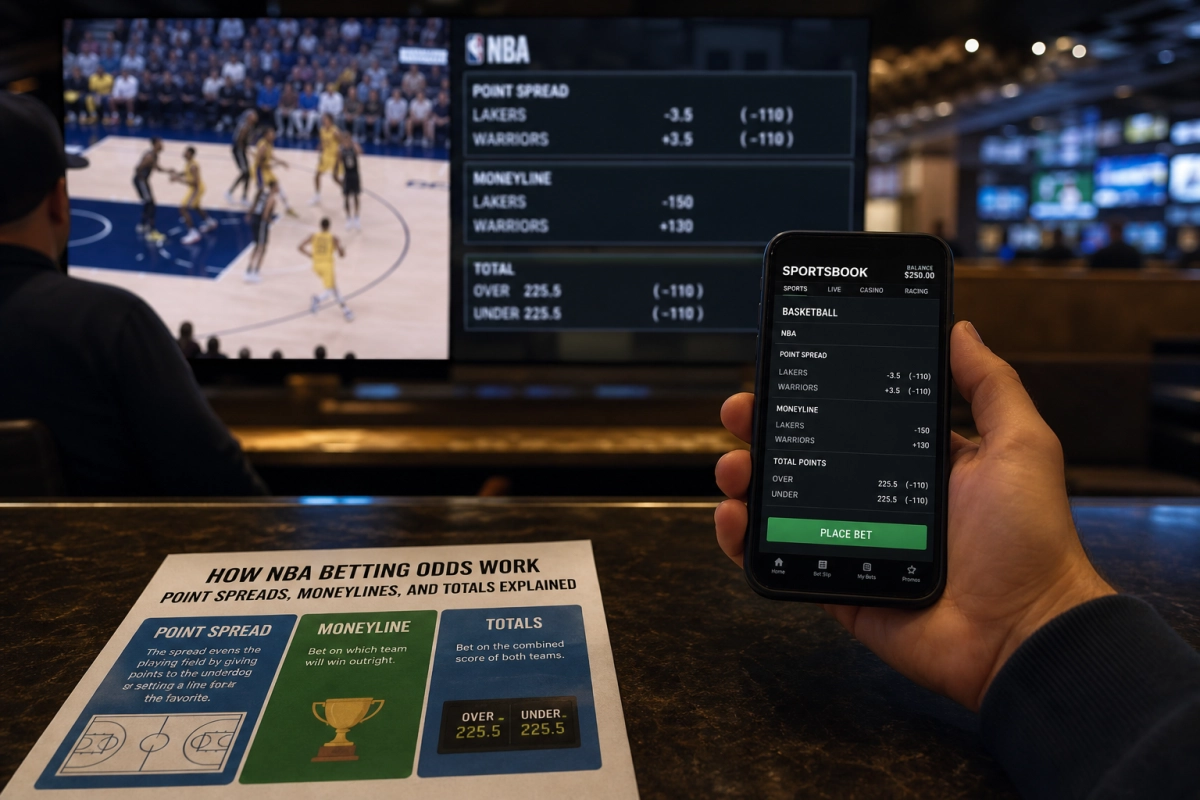
What NBA Betting Odds Actually Tell You
Odds are not simply numbers on a screen. In NBA betting, every figure published by a sportsbook carries a specific meaning — it reflects the implied probability of an outcome, the relative strength of two teams, and the margin the bookmaker builds in to operate profitably. Before placing any wager, understanding what those numbers represent is far more valuable than following any tip or prediction.
Most sportsbooks present NBA odds in one of three formats: American (moneyline), decimal, or fractional. American odds are the dominant format in the United States. A positive number such as +150 indicates how much profit a successful $100 wager returns. A negative number such as -180 shows how much must be staked to return $100 in profit. That asymmetry immediately signals which side the bookmaker considers more likely to win.
The Three Core NBA Betting Markets
The Moneyline: Backing a Winner Outright
The moneyline is the most straightforward bet available — select which team wins, with no point margin involved. A clear favourite carries negative odds, say -220, reflecting a higher implied probability of victory. The underdog carries a positive value such as +185, offering a larger return because the outcome is considered less likely.
Experienced bettors monitor the gap between a team’s actual probability of winning and the probability implied by the odds. When those two figures diverge meaningfully, a potential edge exists — though no edge eliminates the underlying risk.
The Point Spread: Betting on Margin, Not Just Result
The point spread is the most widely used NBA market. Rather than picking a winner outright, the bettor decides whether the favourite will win by more than a specified margin, or whether the underdog will keep the game within it. A spread of -7.5 means the favourite must win by eight or more points for that side to succeed.
Spreads are typically offered at odds close to -110 on both sides, meaning a bettor must wager $110 to profit $100. That built-in margin — the juice or vig — is how sportsbooks maintain their edge. The spread shifts throughout the week as betting volume, injury news, and sharp money all push the number in one direction or another.
Totals: Evaluating Combined Scoring Output
The totals market removes team preference entirely. A sportsbook sets a projected combined score — say, 224.5 — and bettors decide whether the actual total lands above or below it. Totals betting demands an understanding of pace, offensive efficiency, defensive strength, and situational factors such as back-to-back scheduling and key injury absences.
How Sportsbooks Build Their Lines
Before an NBA game appears on a betting board, oddsmakers have synthesized an enormous volume of information — roster availability, travel schedules, recent trends, and historical head-to-head data. The opening line is essentially the book’s best estimate of where public and sharp money will reach equilibrium, not necessarily where they believe true probability sits.
A sportsbook’s primary objective is balanced action — roughly equal money on both sides so the vig guarantees profit regardless of outcome. In practice, perfect balance is rarely achieved, so books sometimes shade lines to attract money to an underexposed side rather than reflect their honest probability assessment. A line is partly a market instrument and only partly a predictive statement.
Sharp bettors — those who wager in volume with a demonstrated track record — have an outsized influence on how lines move. When a substantial wager from a recognized sharp account hits a number, books adjust quickly, sometimes by a full point or more. Tracking where a line opened versus where it currently sits can reveal who has been betting and in which direction, though interpreting that movement requires context rather than a mechanical rule.
Reading Line Movement and What It Reveals
A spread that opens at -5.5 and moves to -7 before tip-off tells a story — but the story changes depending on what drove the move. Injury news can shift a spread dramatically. A star player ruled out two hours before game time will often push the line by three to five points within minutes, reflecting an immediate reassessment of competitive balance.
More subtle is movement driven by betting patterns alone, with no obvious news catalyst. When a line climbs despite heavy public money on the other side, professional volume is likely pushing against the crowd. This scenario — where the line moves contrary to where most tickets are going — is sometimes called reverse line movement, and experienced bettors treat it as a meaningful signal worth investigating.
Totals are equally susceptible to movement. A key ball-handler returning from injury can push a total upward rapidly. Late scratches to a primary scorer often send it downward. Monitoring where a total opens and where it prices at tip-off provides a window into how informed money assessed that matchup throughout the week.
Implied Probability and Why It Shapes Every Betting Decision
Every set of odds can be converted into an implied probability. For negative odds, divide the absolute value by the sum of that value and 100. For positive odds, divide 100 by the sum of the odds and 100. A -200 favourite carries an implied probability of roughly 66.7 percent. A +150 underdog sits near 40 percent.
When doing this calculation across both sides of a market, the combined probabilities exceed 100 percent. That excess — typically four to eight percent depending on the book — is the overround, representing the mathematical edge the sportsbook holds before a single bet is placed.
This reframes what it means to win at NBA betting over time. A bettor backing a team at -110 needs to win that wager at a rate exceeding 52.4 percent simply to break even. Identifying situations where a team’s genuine win probability meaningfully exceeds what the odds imply is the core intellectual challenge — and why fluency with implied probability is not optional for anyone serious about long-term results.
Putting the Framework Into Practice
The process of evaluating a game starts not with a prediction but with a price check — looking at where a line sits, considering what the implied probabilities represent, and asking whether the market’s assessment aligns with an honest independent reading of the matchup.
That means approaching the moneyline with a clear sense of a team’s actual win probability and comparing it against the implied figure the odds embed. It means reading a point spread not as a prediction of final margin but as a threshold the favourite must clear — and identifying the specific factors, from defensive matchups to scheduling fatigue, that make clearing it more or less likely. It means treating a total as a distillation of pace, efficiency, and personnel that can be stress-tested against what is known about both rosters.
None of this guarantees profitable outcomes. The vig ensures the mathematical baseline always favors the house, and variance in professional basketball means even well-reasoned bets lose regularly. What fluency with odds structure provides is a more honest accounting of risk — a way of distinguishing between a wager that offers genuine value at its current price and one that simply feels appealing because of name recognition or popular narrative.
The bettors who sustain results over meaningful sample sizes are not those who find the most compelling stories. They are the ones who have internalized how prices are built, what drives them to move, and where the gap between market probability and true probability is wide enough to justify action. That begins, and in many ways ends, with a clear and practiced reading of the odds themselves.