
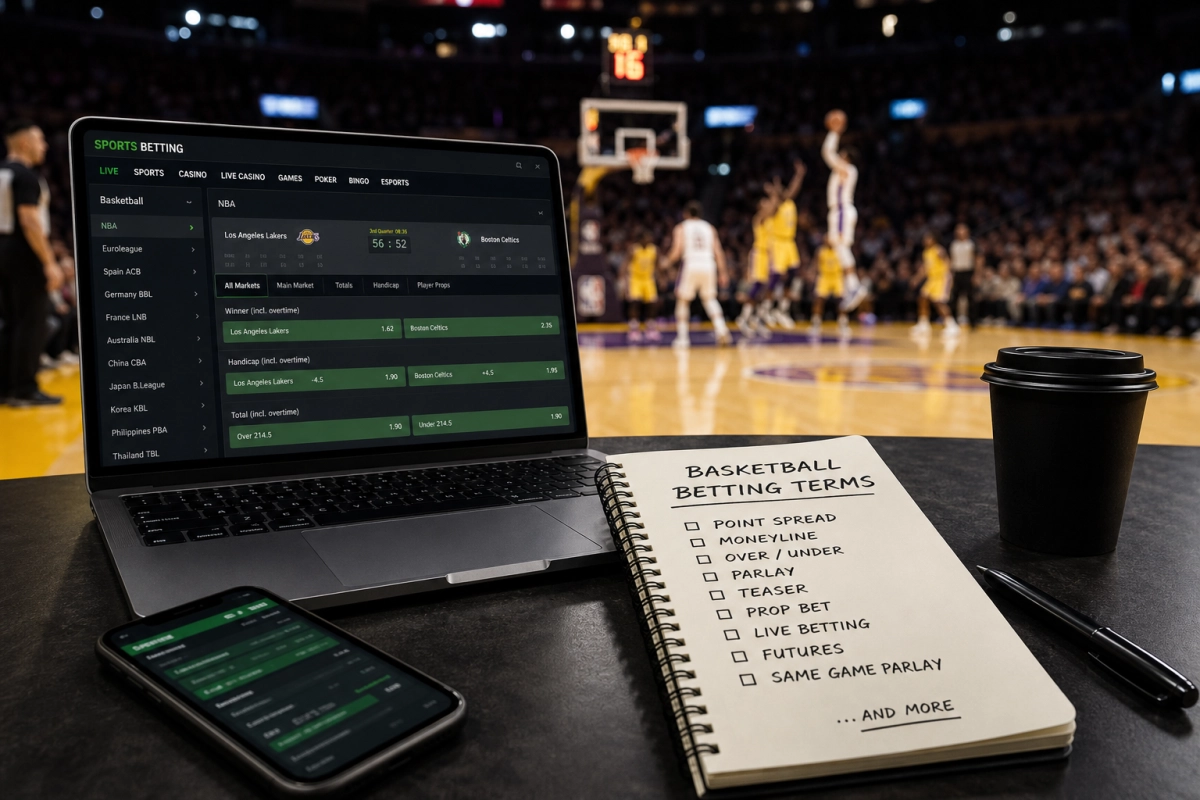
Why Basketball Betting Terminology Matters Before You Place a Wager
Walking into a basketball betting market without understanding the language is like reading a scouting report in a foreign language. The numbers are visible, but the meaning stays out of reach. Whether you are approaching NBA betting for the first time or sharpening how you read odds movements in EuroLeague markets, a firm grasp of basketball betting terminology is the foundation everything else is built on.
This guide covers 25 terms that appear regularly across sportsbooks, betting communities, and market analysis. Some are fundamental concepts you will encounter on virtually every betting slip. Others are more nuanced, reflecting how sharp bettors and professional linemakers think about market dynamics. Understanding how they connect gives you a clearer picture of what is actually happening when odds shift, lines move, or books adjust their numbers mid-week.
The Foundational Terms: Spread, Juice, and How Lines Work
The point spread is the starting point for most basketball bettors. Rather than simply picking a winner, the spread asks whether a team will win by more or fewer points than a set margin. If a team is listed at -7.5, they need to win by eight or more points for a bet on them to succeed. The opposing side at +7.5 covers if they lose by seven or fewer, or win outright. This format levels the field between mismatched opponents and creates a more balanced two-sided market.
Closely tied to the spread is juice, sometimes called the vig or vigorish. Juice is the sportsbook’s built-in margin — the fee embedded in the odds ensuring the book profits regardless of outcome. Standard juice is typically -110 on both sides, meaning a bettor must wager $110 to win $100. That extra $10 is the house’s cut, and understanding it helps bettors calculate their actual break-even win percentage, which sits at roughly 52.4 percent at -110.
The moneyline strips away the spread entirely and asks only who wins. Odds are expressed as positive or negative numbers based on each team’s perceived likelihood of winning. A heavy favourite might be priced at -340, while an underdog at +260 returns $260 profit on a $100 wager. Moneyline betting is particularly common in tight matchups where the spread feels difficult to assess with confidence.
Totals, Handles, and the Opening Line
The total, or over/under, is the combined projected score for both teams. Sportsbooks set a number — say, 224.5 for an NBA game — and bettors decide whether the actual combined score lands over or under. Totals betting requires an understanding of pace, defensive efficiency, rest schedules, and injury context rather than simply predicting a winner.
The opening line is the first spread or total a book publishes, often released days in advance. It reflects the oddsmaker’s early assessment and is set to attract balanced action rather than to be a precise prediction. The closing line is the final odds available before tip-off, shaped by the cumulative weight of public and sharp money that has arrived since opening.
- Handle: The total amount wagered on a game or market.
- Action: Any active wager placed on a game.
- Hook: The half-point added to a spread or total that eliminates the possibility of a push.
- Push: When the final margin lands exactly on the spread, resulting in all bets being refunded.
Sharp Money, Public Betting, and How Books Respond to Both
Sharp money refers to wagers placed by professional or highly experienced bettors whose long-term records have earned credibility with oddsmakers. When sharps bet a side, books pay attention. A significant sharp play often triggers an immediate line adjustment, even if it represents a small percentage of the total handle. These players have demonstrated they find edges, and sportsbooks protect their margins by moving the number before more sharp action follows.
Public money, also called square money, flows from recreational bettors who typically lean toward popular teams, high-scoring totals, and favourites regardless of value. Public bettors drive a large portion of the handle in major NBA markets, and books sometimes shade their lines to capitalise on predictable public tendencies. When a team with a large national fanbase is listed as a moderate favourite, the line might open slightly inflated to account for anticipated public support.
The tension between sharp and public money produces most of the meaningful line movement bettors observe during the week. Understanding which force is driving a shift changes how you should interpret the updated number entirely.
Steam Moves and Reverse Line Movement
A steam move describes a sudden, coordinated wave of sharp action hitting a line across multiple sportsbooks at roughly the same time. Steam moves cause rapid, synchronised movement rather than the gradual drift public money produces. If a game opens at -5 and multiple major books adjust to -6.5 within minutes, a steam move is almost certainly the cause.
Reverse line movement is one of the more telling signals in basketball betting analysis. It occurs when the line moves opposite to the betting percentages. If 70 percent of bets are on the favourite but the spread drops from -7 to -6, sharp money has landed heavily on the underdog, outweighing the volume of public tickets. Reverse line movement is widely regarded as one of the cleaner indicators of where informed money is positioned.
- Limit: The maximum amount a sportsbook will accept on a single wager.
- Beard: A person who places bets on behalf of a sharp bettor whose action a book will no longer accept at full limits.
- Middling: Betting both sides of a game at different numbers in hopes of winning both if the final score lands between the two spreads.
Key Numbers, Line Shopping, and Closing Line Value
Basketball does not carry the same rigid key numbers as football, but certain margins appear with enough frequency in NBA games to carry practical significance. Numbers like five, seven, and ten points see elevated frequency as final margins, meaning the difference between -6.5 and -7.5 can matter more than it initially appears. Experienced bettors track these patterns and treat half-points near meaningful numbers with appropriate care when line shopping.
Line shopping is the practice of comparing odds across multiple sportsbooks to find the best available number. Consistently securing -6.5 instead of -7, or grabbing -108 instead of -110, compounds over hundreds of bets in a way that meaningfully improves overall profitability. Maintaining accounts at several reputable books is considered a baseline requirement by most serious bettors precisely for this reason.
Closing line value, or CLV, measures whether the price you obtained was better or worse than where the market ultimately settled at tip-off. If you bet a team at -4.5 and the closing line lands at -6.5, you captured two points of value relative to the market’s final consensus. CLV is widely used as a long-term performance metric because it reflects your ability to identify edges before the market corrects them — which correlates strongly with sustained profitability over time.
Putting the Vocabulary to Work
A correlated parlay involves linking two bets whose outcomes are connected — for instance, betting a team to win on the moneyline while also betting the under, given that defensive games tend to produce closer scores. Most books restrict correlated parlays because the legs are not independent events, undermining the standard parlay pricing model.
Teaser bets allow bettors to adjust spreads or totals by a set number of points — commonly four or five in basketball — in exchange for reduced payout odds. Moving a -8 favourite to -3 sounds appealing, but the reduction in odds must reflect genuine value, and in basketball that calculation is less favourable than in football where key numbers are more concentrated.
- Futures: Bets placed on season-long outcomes such as a championship winner or award recipient, settled at season’s end.
- Live betting: Wagering on a game after it has begun, with odds adjusting in real time based on score, momentum, and time remaining.
- Fade: Betting against a team or position — to fade the public means taking the opposite side of where recreational money is concentrated.
Live betting deserves particular attention in basketball because the sport’s pace creates constant market fluctuation. A ten-point swing in the second quarter can move a spread dramatically, opening short windows of value that disciplined bettors learn to identify quickly. The same principles of sharp money, closing line value, and line shopping apply in live markets — they simply require faster decision-making and a clear pre-game framework to lean on.
The Language You Carry Into Every Line You Read
Fluency in basketball betting terminology does not guarantee winning bets, but the absence of it almost guarantees preventable mistakes. Misreading juice, ignoring reverse line movement, skipping line shopping because the effort feels marginal, or chasing a steam move too late — these are the kinds of errors that erode results quietly over time, rarely dramatic enough to trace back to a single moment of confusion.
What this guide has covered represents the working vocabulary of anyone who takes basketball betting seriously: from the mechanical structure of the spread and moneyline, through the market dynamics driven by sharp and public money, into the more refined metrics of closing line value and key number awareness. These twenty-five terms do not represent a ceiling. They represent a floor — the baseline beneath which serious analysis cannot comfortably begin.
The next time a line moves in an unexpected direction, or a sharp steam move sweeps through a market before you have placed your wager, the language to understand exactly what is happening is already in your hands. That clarity, compounded across an entire season, is worth considerably more than any single bet you will ever place.