
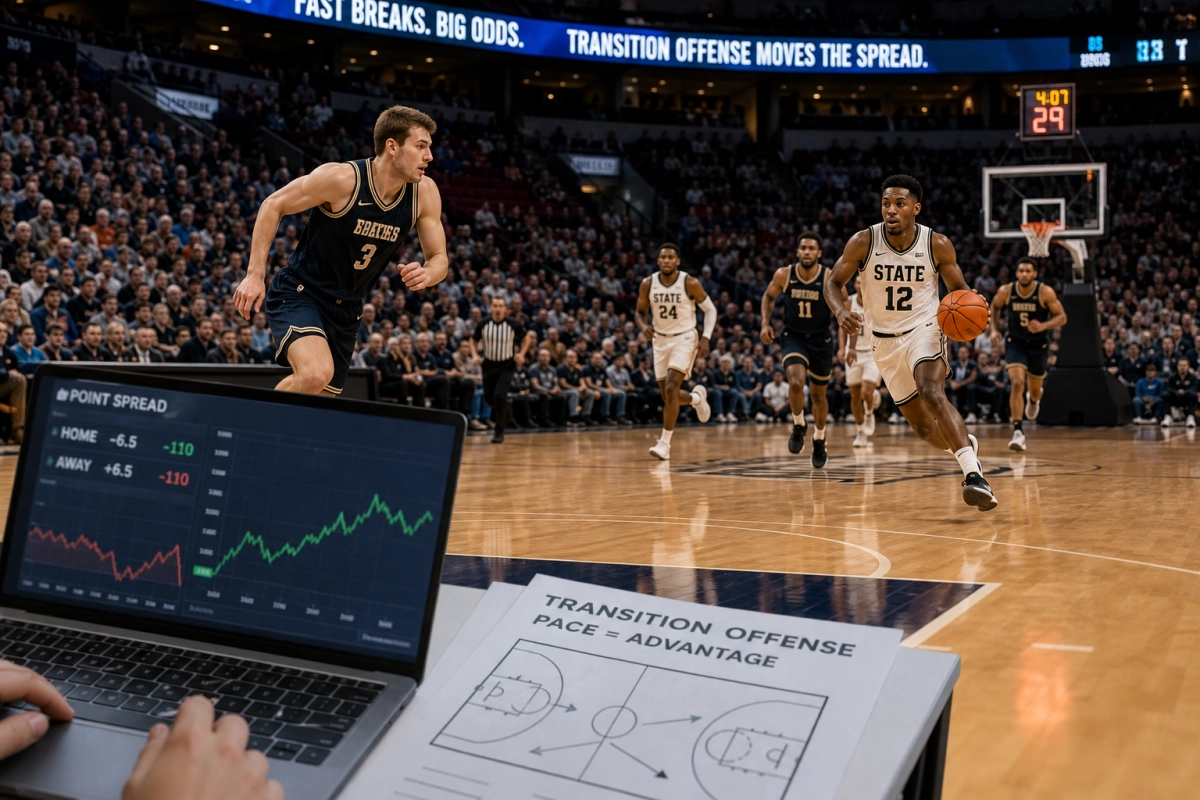
Why Playing Style Shapes the Point Spread More Than Most Bettors Realise
Point spread betting is often discussed in terms of matchup quality, injury reports, and recent form. Those factors matter. But one element that receives less attention is playing style — specifically, how a team generates its offense and at what speed. Transition offense basketball, built on fast breaks, quick outlet passes, and outrunning the defense, has a measurable effect on game scoring patterns and, by extension, on how spreads behave across a season.
For bettors who want to move beyond surface-level analysis, understanding the relationship between pace, transition frequency, and margin volatility is a genuinely useful edge. Not because it removes risk, but because it adds context that sportsbooks price in and many recreational bettors overlook entirely.
What Transition Offense Actually Means in Statistical Terms
Transition offense refers to the phase of play where a team attacks before the opposing defense has time to recover and organise. It begins the moment a possession changes and ends either with a shot in open space or when the offense resets into a half-court set. Teams that deliberately push pace want to maximise possessions within that window.
The relevant metrics include pace (possessions per 48 minutes), fast break points per game, and the proportion of field goal attempts taken within the first few seconds of a possession. High-pace teams regularly generate a meaningful share of their scoring from transition at higher efficiency than their half-court sets. More possessions and higher open-play scoring rates create conditions where games are more likely to be decided by larger margins — or where those margins become harder to predict.
Pace, Possessions, and Spread Volatility
The point spread represents a bookmaker’s estimate of the expected margin between two teams. When a high-transition team faces an opponent that struggles to defend in open court, the conditions for a wider-than-expected margin are present. But fast-paced games introduce variance, and a team that lives in transition can just as easily fall short if shooting efficiency dips on a given night.
This is why transition-heavy teams sometimes produce erratic results against the spread. Their scoring ceiling is high, but so is their floor variance. Bettors who treat pace purely as a positive signal without accounting for defensive vulnerabilities and efficiency fluctuations can misjudge spread coverage frequency over a sample of games.
- High-pace teams often post more possessions per game, creating wider potential scoring ranges.
- Transition frequency affects both offensive efficiency and the opponent’s counter-transition opportunities.
- Spread volatility increases when two fast-paced teams meet, or when a slow half-court team faces a run-and-gun opponent unprepared for the tempo shift.
How Roster Construction Determines Transition Identity
A team’s transition tendencies are baked into its roster. Personnel decisions made in the offseason — which guards are acquired, how athletic the frontcourt is — dictate how capable a team is of executing in open space. The point guard role is central. A ball-handler who pushes pace immediately after a change of possession and makes decisions at speed is one of the most valuable assets a transition offense can have. Wing players with straight-line speed who fill lanes and catch passes in stride extend the transition window beyond what the primary handler alone creates.
Frontcourt players matter in ways that often go unexamined. A center who grabs a defensive rebound and immediately initiates the outlet pass compresses the time available for the opposing defense to recover. A slow-footed big who struggles to trail the play becomes a liability because defenses can drop back without consequence. Teams with athletically versatile front lines often rank higher in transition frequency metrics despite not being conventionally labelled as up-tempo teams.
Matchup Conditions That Amplify or Suppress Transition Volume
Even a roster built for transition will not generate the same fast-break volume every night. One of the most reliable suppressors is defensive rebounding discipline. Teams that crash the offensive glass aggressively force opponents to send extra bodies to box out, delaying the outlet and reducing viable runners ahead of the ball. A high-transition team facing elite offensive rebounding rates may find its pace constrained purely by possession logistics.
Foul trouble is another underappreciated variable. When a team’s primary transition initiators accumulate early fouls, the tempo flattens accordingly — backup guards rarely replicate the decision-making speed of starters. Monitoring foul tendency data gives bettors a meaningful lens for evaluating whether a spread built around a transition identity remains valid once the game is underway.
- Offensive rebounding rates from the opposing team can meaningfully delay outlet opportunities and reduce transition volume.
- Foul trouble among key initiators tends to slow pace in ways that live betting markets are sometimes slow to adjust to.
- Back-to-back scheduling frequently reduces transition frequency as leg fatigue limits the sustained effort fast-break basketball demands.
Spread Pricing Tendencies for Transition-Heavy Teams
Sportsbooks factor pace and offensive style into their pricing models, but they are not infallible. One consistent pattern is how transition teams are priced in games projected to be low-scoring. When a fast-paced team faces a slow, deliberate opponent, the market often prices the game around an intermediate tempo. In practice, the slower team typically wins the pace battle more often than not — disciplined half-court defenses and careful shot clock management are tactically effective at reducing possessions. When that suppression occurs, a transition team’s scoring output can fall noticeably below its season average, creating cover misses that bettors anchored to pace data may not have anticipated.
The opposite scenario is less frequently accounted for: when two high-transition teams meet, scoring can spike well above the posted line if both teams are also poor defensive units in open court. Identifying these specific game profiles — rather than applying transition logic uniformly — is where the genuine analytical value lies.
Applying Transition Analysis Practically Within a Betting Framework
The value of understanding transition offense in spread betting is not that it produces automatic wins. It disciplines the analytical process. Bettors who build transition awareness into their preparation are less likely to be caught by scoring swings that look unpredictable in isolation but make structural sense when pace and personnel factors are considered beforehand.
The most practical approach is to treat transition profile as a filtering mechanism rather than a primary signal. When a spread looks attractive on the surface, asking a second layer of questions — how does this team generate offense in open court, what does tonight’s opponent do to disrupt that, and are there scheduling or personnel factors that alter the tempo expectation — narrows the field to games where the spread price and likely game environment are genuinely aligned.
Tracking transition metrics over a rolling window, rather than relying on season averages, also sharpens the picture. A team that ranked among the league’s fastest in October may be playing at a noticeably different pace by February, and a spread priced against the older data profile may no longer reflect current reality.
- Use transition data as a filter, not a standalone reason to bet a side — matchup context always matters.
- Rolling pace metrics over recent games are more predictive than season-long averages for identifying genuine tempo trends.
- Game environment factors — schedule density, venue, personnel availability — should be layered on top of stylistic analysis before any spread decision is finalised.
Where Style Meets the Spread, and Why the Detail Matters
Basketball is a game of possessions, and possessions are not uniformly distributed or equal in quality. Transition offense compresses the time available to defend, inflates scoring potential in short bursts, and introduces variance that well-set spreads sometimes underestimate and sometimes overstate. Recognising which situation applies on a given night — and why — is the work that separates considered betting from guesswork dressed in statistics.
The relationship between playing style and spread outcomes is not a formula. It is a framework for asking better questions. When that framework is applied consistently, with honest attention to what the data does and does not support, it becomes one of the more durable analytical tools available to bettors who take the craft seriously. The teams running the floor fastest are not automatically good bets, nor are they bad ones. The answer, as always, lives in the specifics — and those specifics reward the bettors who go looking for them.