
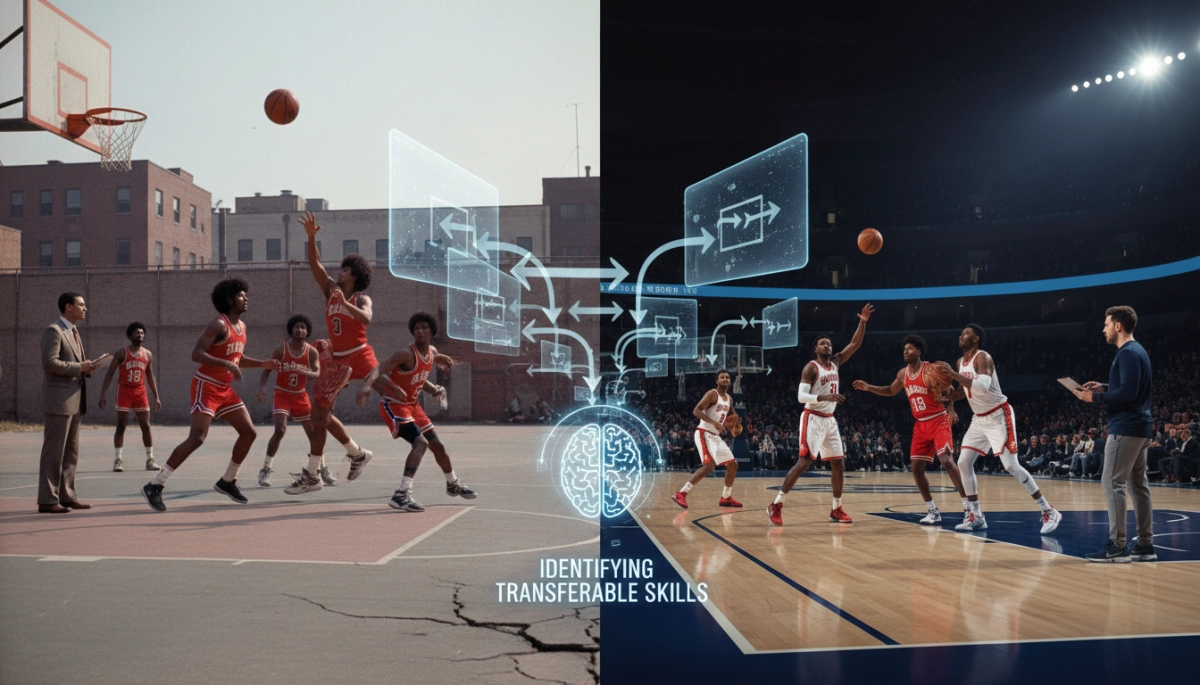
Bridging Two Basketball Worlds: Why ABA-to-NBA Scouting Demands Context
You often encounter prospects who dominate the ABA but raise questions about how their game will translate to the NBA. As a scout, coach, or front-office evaluator, you must separate raw production from translatable skills. The ABA’s pace, rules, and talent mix can inflate certain stats while masking deficits that matter at the NBA level. Conversely, some abilities are undervalued in ABA box scores yet become premium in the pros. Your job is to read beyond numbers and identify the traits that will survive a jump in speed, physicality, and strategic complexity.
Start by framing the ABA performance within context: line up the player’s role, the opponent quality, and the pace of play. Ask how a defender, playmaker, or shooter would fare against NBA-caliber athletes and schemes. This contextual approach reduces evaluation bias and clarifies which skills are pure and which are circumstantial.
A Practical Framework to Identify Transferable Skills
On-court skills that scale
Certain observable skills translate more reliably across leagues. When you watch film, focus on:
- Shot mechanics and consistency: Efficient, repeatable shooting form predicts long-term carryover, especially from midrange and three-point range.
- Creation and decision-making: Ability to create a shot or assist under pressure—using change-of-direction, counters, and reads—is crucial when defenders are quicker and more disciplined.
- Defensive fundamentals: Footwork, awareness, and ability to guard multiple positions indicate a higher floor defensively than raw steal or block numbers alone.
Physical profile and developmental indicators
Physical traits alone don’t guarantee success, but they set ceilings and floors. You should evaluate:
- Explosiveness and lateral agility: Measurable quickness helps predict whether a player can keep pace with NBA athletes on both ends.
- Frame and strength trajectory: A young player with room to add functional strength projects better than one who is physically maxed out for their position.
- Durability and minutes history: Consistent high-minute stretches against solid competition are predictive of how a prospect will handle NBA workloads.
Basketball IQ, fit, and adaptability
Intangibles often determine whether a skill set translates. You should assess:
- Coachability and response to scouting adjustments: Players who adapt quickly in-game and between practices are more likely to refine weaknesses at the next level.
- Role flexibility: Ability to accept off-ball duties, run set plays, or switch defensively increases a prospect’s value in varied NBA systems.
- Competitive instincts: How a player reacts in late-game, high-pressure situations often separates transient ABA stars from durable NBA contributors.
With this framework you turn raw ABA output into a structured projection of NBA potential. In the next section you’ll apply these criteria to specific skill groups and walk through film cues, measurable thresholds, and red flags that clarify true transferability.
Translating Scoring: Shooting, Creation, and Off-Ball Movement
Shooting and scoring are the most visible outputs, but they’re also the easiest to misread coming from the ABA. Rather than treating points-per-game as gospel, break scoring into components that project independently: catch-and-shoot shooting, off-dribble creation, finishing at the rim, and off-ball movement. Each has distinct film cues and measurable thresholds that predict NBA carryover.
Catch-and-shoot
- Film cues: consistent footwork on the catch (square, balanced), quick, compact release, and the ability to shoot off screens without predictable timing. Look for rhythm on consecutive possessions—does the shooter perform the same way in early and late clock situations?
- Thresholds to like: sustained three-point percentage in the high-30s on respectable attempts; free-throw rate above position average as a proxy for shooting touch.
- Red flags: long, slow release; shot reliant on step-backs rather than catch rhythm; dramatic splits between uncontested and contested makes.
Off-dribble creation
- Film cues: quality of first step, change-of-pace counters, ability to separate left and right, and decision-making after beating a defender (finish, pull-up, or find the roller). Prioritize plays against length and athleticism, not just soft closeouts.
- Thresholds to like: low turnover rate relative to usage; demonstrated ability to create a higher percentage and/or foul-drawing opportunities against top competition.
- Red flags: creating primarily via isolation against slower defenders, predictable shotgun one-dribble pull-ups, or a handle that breaks down under pressure.
Finishing and craft around the rim
- Film cues: use of body to create separation, ability to finish through contact with either hand, midrange touch such as floaters and runners to compensate for paint congestion.
- Thresholds to like: consistent finishing on contested shots in transition and half-court; ability to convert when attacking closeouts.
- Red flags: overreliance on uncontested drives, inability to absorb contact, or poor touch with the off-hand.
Off-ball movement and gravity
- Film cues: intelligent cuts, timing on backdoor actions, and ability to read closeouts to exploit mismatches. Players who make simple plays—flare screens, stagger actions, relocation—become easier fits at the next level.
- Thresholds to like: consistent catch-and-score efficiency from movement possessions and demonstrable screen navigation skills.
- Red flags: static tendencies, inefficient footwork in space, or an inability to influence defenses without the ball.
Defense, Rebounding, and Athletic Fit: Film Cues, Thresholds, and Red Flags
Defense and athletic profile are where ABA-to-NBA gaps can be most revealing. Numbers like steals and blocks are noisy; instead, evaluate repeatable behaviors that survive tougher matchups and more complex schemes.
On-ball and team defense
- Film cues: hand positioning that challenges but doesn’t foul, drop-and-recover timing on screens, and consistent communication on rotations. Look at the player’s reaction to advantage situations—do they hedge properly or abandon structural principles for chase plays?
- Thresholds to like: ability to stay in front of primary ball-handlers in isolation sequences, and success on switch-heavy actions without creating mismatches.
- Red flags: late or habitual over-help, poor closeout mechanics (lunging or flattening out), and a tendency to gamble for steals that leads to defensive breakdowns.
Rim protection, switching, and positional versatility
- Film cues: verticality at the rim, recovery speed from the perimeter to help defense, and effectiveness when switched onto smaller or quicker opponents. Prioritize plays where the player defends multiple coverages in the same game.
- Thresholds to like: demonstrable success defending pick-and-roll on both the ball and in drop/ice schemes; rebounding rate that shows effort and timing, not just athletic advantage.
- Red flags: inability to contest without fouling, slow recovery on rotations, or limited lateral range that forces constant help.
Athletic fit and durability
- Film cues: sustained effort across long stretches, body control in traffic, and movement quality—how a player decelerates, changes direction, and re-accelerates.
- Thresholds to like: physical metrics (wingspan relative to height, explosive traits) that give positional leeway; a minutes history showing readiness for heavier workloads.
- Red flags: chronic conditioning shortfalls, dependence on superior athleticism rather than technique, or a frame that looks taxed when matched with stronger opponents.
Applying these film cues and thresholds helps you filter surface-level ABA production into a realistic projection. The best prospects check multiple boxes—repeatable shooting mechanics, adaptable playmaking, defensive IQ, and an athletic profile that maps cleanly to an NBA role. The remainder of the evaluation process then becomes about projection: where can coachability and physical development close remaining gaps?
Putting Projection Into Practice
Scouting across leagues is as much a mindset as a methodology. The most effective evaluators blend humility with conviction: be willing to revise a projection when new evidence appears, but hold fast to a consistent framework that separates noise from true skill. Treat each ABA-to-NBA assessment as an experiment—define your hypotheses about transferability, collect both qualitative and quantitative evidence, and iterate.
Practical steps for evaluators
- Standardize what you track: build a short, repeatable checklist for film sessions that highlights the handful of traits you trust most (shooting mechanics, change-of-direction, decision-making under pressure, defensive fundamentals).
- Cross-validate: combine eye-test observations with measurable data from workouts and combines to reduce single-source bias.
- Contextualize workloads: simulate NBA scenarios in private workouts—pace, physicality, and read-and-react drills—to test adaptability rather than raw numbers alone.
- Engage development staff early: align on what can be improved with coaching and what is structural or physical, so projections factor in realistic development timelines.
- Track outcomes: maintain a simple database of past projections and results to refine your thresholds and identify systematic scouting errors.
Finally, stay curious and connected. Follow league-level testing and trend data—such as combine protocols and measurable baselines—so your benchmarks remain current and relevant. A helpful reference for official testing standards is the NBA Draft Combine.
Good scouting recognizes that translation is probabilistic, not binary. Your job is to reduce uncertainty: create clear criteria, test them consistently, and be deliberate about where you place your confidence. That disciplined approach is what turns ABA standouts into realistic NBA contributors—or quickly exposes when a skill won’t survive the jump.