
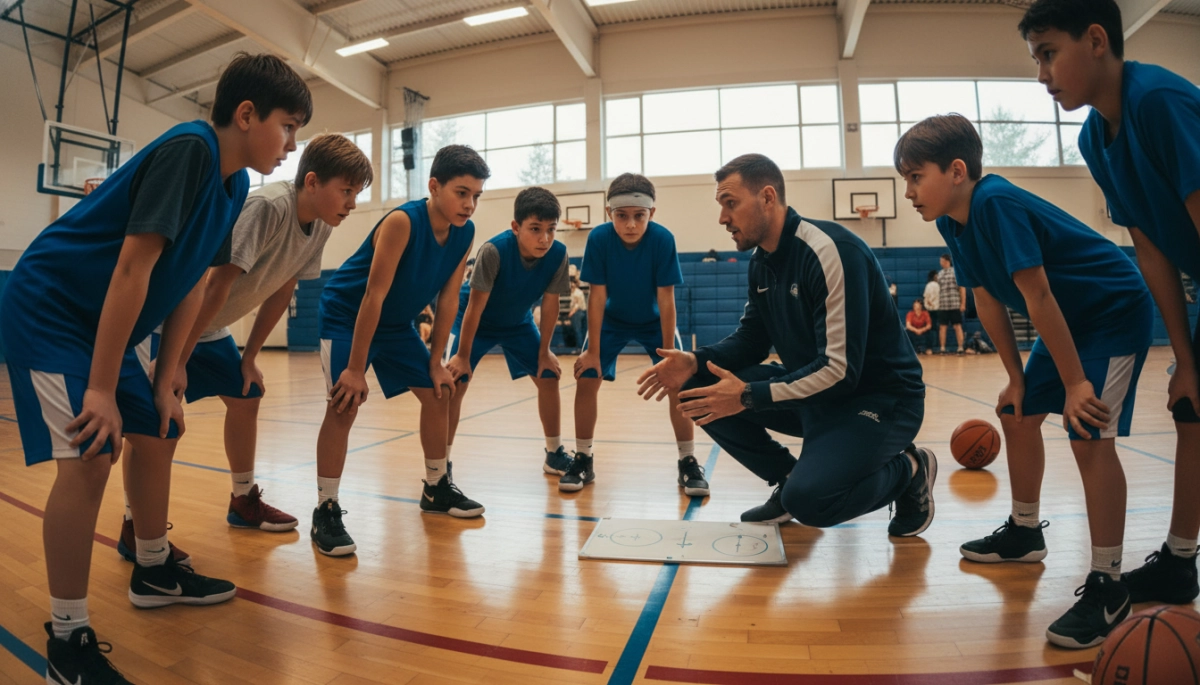
Building a Defensive Identity from Day One: What you should prioritize
When you introduce defense to a young team, you’re not just teaching technique — you’re shaping an identity. A defensive identity is a set of shared expectations and habits players default to under pressure. If you want consistent effort and reliable outcomes, emphasize simple, repeatable behaviors that map to both ABA principles (applied behavior analysis) and basketball fundamentals: clear cues, consistent reinforcement, and measurable targets.
Start by setting three non-negotiables that every player understands and can demonstrate: effort (active feet and hands), attention (eyes on the ball and help-side awareness), and accountability (communicating and finishing plays). Keep language concrete and observable so you can praise correctly and shape behavior effectively.
Quick checklist: Core behaviors to teach first
- Stance and ready position: feet shoulder-width, knees bent, weight on balls of feet.
- Ball pressure: close enough to influence the dribbler without overcommitting.
- Help-side posture: body angled to see ball and man, prepared to rotate.
- Communication: call screens, switches, and rebound responsibilities out loud.
- Finish every play: box out and pursue the rebound even after a stop.
How to structure practices so defense becomes automatic
To make defensive behaviors automatic, you must design practices that use repetition with variability and timely feedback. ABA strategies map well: break complex skills into small steps, reinforce successive approximations, and use clear prompts that you fade as players internalize the behavior. Organize the session into predictable segments so players know what’s expected and you can measure progress.
- Warm-up rituals (5–10 minutes): Use the same defensive activation each practice — slides, closeouts, and a short communication drill. The ritual cues the mindset shift from offense to defense.
- Micro-skills stations (15–20 minutes): Rotate players through focused stations: 1-on-1 containment, help-and-recover, and closeout-to-rebound. Keep reps high and correct errors immediately with short, specific feedback.
- Controlled team drills (15 minutes): Use semi-live scenarios (e.g., 3-on-3 shell work) to practice rotations and recovering. Stop frequently to reinforce desired behaviors rather than only correcting mistakes.
- Reinforcement and reflection (5–10 minutes): End with quick stats (defensive stops, communication counts) and highlight two to three players who demonstrated the identity you’re shaping. Provide one focused goal for the next practice.
By embedding clear routines and targeted reinforcement into each practice, you’ll create predictable learning environments where young players can adopt and internalize defensive habits. Next, you’ll learn specific drills and in-game cueing strategies that translate these practice behaviors into competitive performance.
Drills that translate: quick, measurable progressions
Choose drills that isolate one observable behavior, allow high reps, and have a clear success criterion. Below are three compact progressions that map directly to the checklist behaviors and use ABA-friendly shaping and reinforcement.
- Closeout-to-Rebound (8–10 minutes): Start with a partner at the wing. Defender begins in stance, coach signals pass; defender closes out with choppy short steps, contests, then immediately boxes out and pursues the rebound. Success criteria: 90% of reps show upright hands on closeout, two-foot plant on contest, and initial contact on box-out. Shape by rewarding any approximation (e.g., correct footwork without full box-out) and fade prompts as players improve. Track consecutive successful reps per player and set short-term goals (e.g., 5 in a row).
- Containment Ladder (10 minutes): Set four stations for 1-on-1 containment: stance/slide, deny baseline, on-ball pressure, and forced weak-hand. Run fast 30–45 second rotations with a coach providing a single corrective cue per rep (e.g., “squeeze” for hand pressure). Use a variable reinforcement schedule: immediate praise for correct reps early, then intermittent praise as behavior stabilizes to encourage persistence under reduced reinforcement.
- Shell with Micro-Goals (15 minutes): Run standard 4-on-4 shell but stop after 4–6 offensive passes. Before each live sequence, assign a measurable micro-goal: “Two communication calls,” “no blow-bys,” or “contest every shot.” Immediately after the sequence, record whether the team met the micro-goal (binary success/fail). Reinforce success with brief, specific praise and one correction for failure. This links practice targets to game-like rotations and makes progress visible.
Cueing and reinforcement during games: precise prompts that stick
In games, keep prompts short, consistent, and action-oriented. Your language should be the same as in practice so cues transfer seamlessly. Rigid coaching phrases reduce processing time and create a common language the team can react to without overthinking.
- Primary in-game cues: “Ball!” (locate and guard), “Help!” (defensive rotation), “Shot!” (box out and rebound), “Screen!” (show, hedge, or switch depending on call), “Take it” (encourage contest or commit to help). Teach players to echo key calls — hearing the call reinforces it and increases likelihood of compliance.
- Correction protocol: Limit coach interruptions to one concise cue per stoppage. Use a three-step fade: full verbal + demonstration → single-word cue → nod/eye contact. This fading mirrors prompt hierarchies in ABA and prevents dependence on the coach.
- Positive reinforcement in real time: Use immediate, behavior-specific praise (“Great closeout, Sam — feet and hands!”) rather than generic “good job.” When verbal reinforcement isn’t practical, use a gesture (pointing to chest for “identity”) or quick thumbs-up from the bench. Reserve public praise for moments that model the identity for the group.
Simple metrics you can use every week
Measure behavior, not feelings. Pick 2–3 metrics you can reliably collect in practice and games and review weekly with the team.
- Defensive stops per 10 possessions (practice and game)
- Communication count per defensive possession (tallied during controlled scrimmages)
- Rebound success percentage after contested shots
Record these as quick numbers on a clipboard or whiteboard. Share trends with players: “We improved communication from 3.2 to 4.1 calls per possession this week.” Small, measurable wins reinforce the identity and make abstract ideas (like “be a stop-first team”) concrete and trackable.
Next steps to make defense the team’s default
Culture change happens one consistent choice at a time. Your role as coach is to create the conditions where the preferred defensive actions are easier, more obvious, and more rewarding than the alternatives. Stay disciplined about the cues, reinforcement schedules, and measurable targets you use — and resist the urge to overload players with too many corrections at once.
Try a focused experiment for the next three practices: pick one observable behavior, set a measurable success rule, and collect simple data. Use that feedback to decide whether to raise the bar, maintain, or simplify the target. Small, iterative cycles of practice, measurement, and adjustment align directly with ABA principles and accelerate adoption of the defensive identity.
- Choose one micro-goal for your next practice and announce it clearly to the team.
- Track that goal with a single metric (e.g., consecutive successful reps or binary success/fail in shell work).
- Give behavior-specific praise immediately when you see the target met; fade prompts as players improve.
For more on building positive, performance-minded team cultures and practical coaching tools, see Positive Coaching Alliance. Keep the focus narrow, measure what matters, and celebrate the small wins that create lasting defensive identity.