
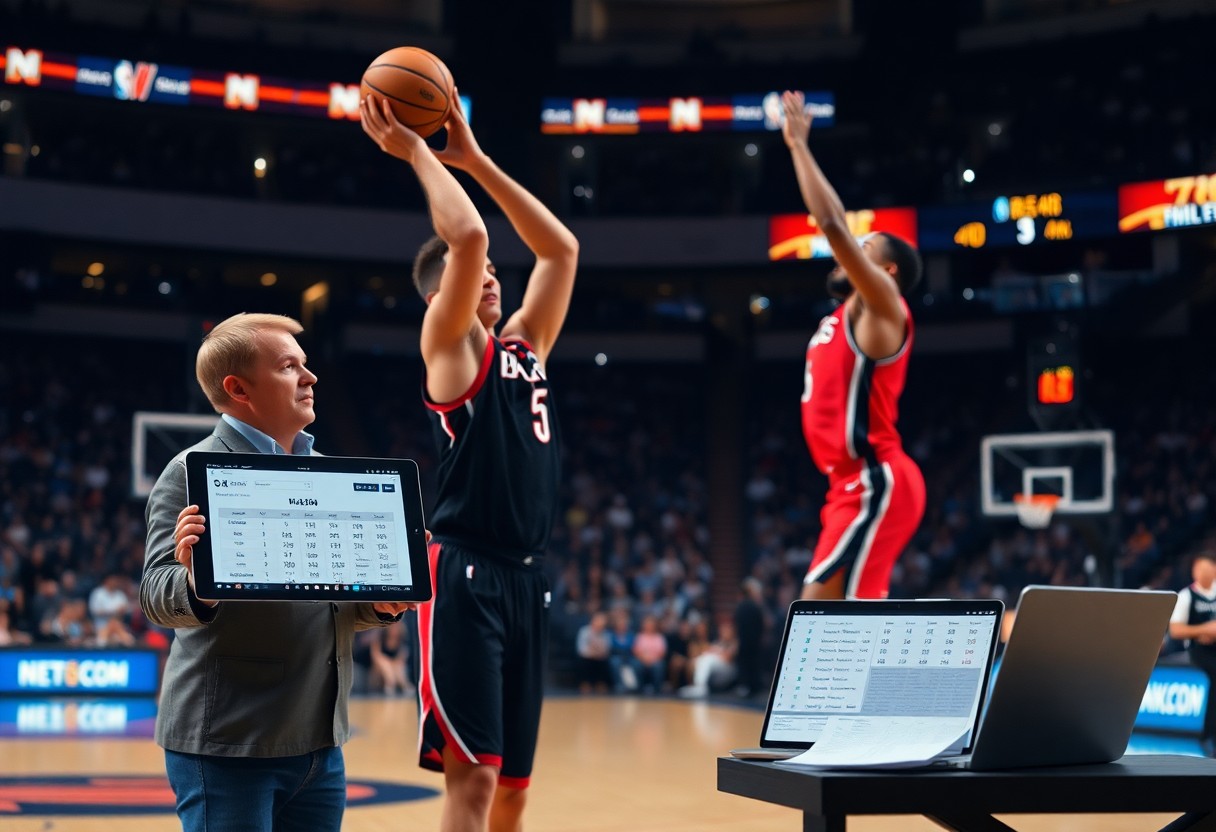
Matchups shape player point bets by altering opportunity and difficulty: defensive schemes and team pace change shot volume and efficiency, while rotations, injuries, and matchup mismatches introduce the most dangerous variance; a careful read of opponent tendencies reveals favorable matchups that boost scoring upside for bettors.
Types of Player Point Bets
Several wager types change how a matchup alters scoring expectations: Total Points lines (commonly set at .5 like 22.5) react to pace and defensive rating, while Alternative Points move the line ± points for different payouts; live markets shift rapidly with minutes and injury news. This player point bets structure forces bettors to weigh matchup-driven volume against variance.
- Total Points – standard over/under on a player’s game points
- Alternative Points – adjusted lines (e.g., 19.5 or 25.5) with different odds
- First-Half Points – in-game splits that reflect coaching pace
- Live/In-Play – lines update with real-time matchup flow
- Range/Combo – bets on point bands like 10-19
| Total Points | Over/Under on final points (e.g., 22.5) |
| Alternative Points | ± lines (e.g., 19.5/25.5) with adjusted odds |
| First-Half Points | Half-game line reflecting tempo and rotations |
| Live/In-Play | Real-time lines reacting to minutes and foul trouble |
| Range/Combo | Point bands or parlay-able segments for payout variation |
Total Points Bet
Lines are often set using a player’s season average, recent form, and opponent defensive rating; for example, a 24.3 PPG guard facing a defense allowing 27.0 PPG may make an over 23.5 line attractive. Market movement after minutes news or injuries can swing value by 1-3 points, so factor opponent pace and bench matchups when evaluating Total Points bets.
Alternative Points Bet
Alternatives let you take higher or lower thresholds than the main line-say 19.5 or 25.5 versus 22.5-trading probability for bigger or smaller payouts; sportsbooks price these with different vig so an alt 25.5 might offer +150 while 19.5 pays -140. Matchup context, like a weak perimeter defense, often makes upward alts more appealing for Alternative Points.
More deeply, Alternative Points require assessing implied odds: if main over 22.5 is -110 (implied ~52.4%), an alt over 25.5 at +150 implies about a 40% chance – use matchup-specific stats (opponent points allowed, defensive ratings, recent minutes) to find when the market misprices that swing. This approach favors lines where volume, pace, or matchup exploitation changes the real probability more than the posted odds reflect.
Tips for Successful Betting
Prioritize matchup edges and process rather than gut feel; track opponent defensive splits, pace, and rotations to spot value. Use quick checks:
- player point bets
- team matchups
- pace
- injuries
Bet sizing, line shopping and exposure limits prevent blowups when variance hits. This disciplined, matchup-driven approach increases long-term edge.
Analyze Matchup History
Compare the last 8-10 head‑to‑head games for trends: a scorer who averages +3.5 PPG vs a team over that span or draws the opponent’s weak perimeter defender more often signals repeatable value, while sustained declines across 10 games usually indicate a tactical change; weigh split stats against game scripts and recent rotations.
Consider Player Form
Monitor rolling windows-5‑game averages for points, shot attempts, and minutes-since a player with a 5‑game average of 22 PPG on 18 FGA and 34 MPG is likelier to clear a baseline line than one at 12 PPG and 25 MPG; also flag usage spikes after injuries or trades.
Dig deeper into form by tracking workload trends, back‑to‑back effects and role stability: players often dip 2-4 PPG on second nights, rookies vary ±5 PPG week‑to‑week, and a coach stating a planned minutes increase can translate to +3-6 expected points when paired with steady usage; treat sudden minutes volatility as the biggest risk to lines and adjust stakes accordingly.
Step-by-Step Betting Strategy
| Step | Action |
|---|---|
| 1 – Identify candidates | Filter players with ≥25% usage or ≥28 MPG and recent form (last 5 games). |
| 2 – Check matchup metrics | Compare player role vs opponent’s PPP allowed and DvP by position. |
| 3 – Monitor injuries/rotations | Adjust for absences: backups often gain +8-15 MPG and +4-10% usage. |
| 4 – Factor pace & minutes | Use team pace (possessions/game); +3-5 possessions can add points/rebounds. |
| 5 – Shop lines & size stakes | Compare books, bet 1-2% bankroll per edge, increase size only with clear data. |
Research Team Statistics
Analyze opponent defensive rating, pace (possessions per 48), and DvP by position; for example, a team allowing >1.10 points per possession to guards and 95 FGA to guards per game signals a strong over opportunity for high-usage guards. Cross-reference last 10 games and home/away splits, and prioritize matchups where the player’s usage exceeds the opponent’s average allowance by several percentage points.
Monitor Injury Reports
Track morning reports and coach announcements: when a starter is listed OUT, backups typically pick up an extra 8-15 minutes and usage often rises by 4-10 percentage points, which can convert a marginal prop into a value play. Watch for QUESTIONABLE tags that flip to OUT close to tip-off and adjust exposure accordingly.
Dig deeper by following team beat reporters and official team lines; check projected starting lineups 30-60 minutes before tip and watch market movement-sharp money often reacts to last-minute injury news. Use historical backup performance: if a bench player averaged 0.8 points per minute in spot starts, expect ~6-12 additional points with an 8-15 MPG bump; size bets 10-25% higher only when both minutes and usage trends confirm the projection.
Factors Influencing Outcomes
Team tendencies like opponent defensive rating, switching frequency, and rotation depth directly reshape a player’s opportunity and shot quality. Facing a top-10 defense can cut a high-usage guard’s attempts by 2-4 shots and lower effective field goal percentage; conversely, teams that force turnovers or concede second-chance points inflate role-player outputs. Pay attention to recent lineup data, foul rates, and matchup-specific metrics such as opponent three-point rate. Any model should dynamically weight these factors when adjusting a player’s point-line.
- Defensive Matchups
- Pace and possessions
- Usage Rate and minutes
- Rotation Depth / bench minutes
- Injuries / lineup changes
- Home/Away and travel
Defensive Matchups
Teams that clamp down on isolation scoring or excel at perimeter containment force volume scorers into fewer, tougher shots: top-5 defenses often limit opponents under 110 points per 100 possessions, and that shift commonly trims a primary scorer’s expected points by 15-25%. Analyze who defends the ball (single matchups vs. frequent switching) and look at opponent rates for contested midrange and catch-and-shoot threes to project efficiency declines and attempt suppression.
Pace of Play
Pace directly scales opportunity: the league average sits near 98-101 possessions per 48 minutes, so a matchup that adds 5-10 possessions typically creates several extra shot attempts and free-throw chances across starters. Translate possession swings into projected attempt changes for high-usage players and adjust point-lines; for example, a 10-possession uptick can mean roughly 8-12 additional team shot attempts, benefiting primary ball-handlers most.
Dig deeper by converting player production to per-100-possession rates: a scorer averaging 30 points per 100 possessions will scale predictably with pace changes, while efficiency shifts (e.g., more transition baskets) can amplify or mute that effect. Use recent game-level possession estimates and opponent tempo rank to quantify expected point swings rather than guessing from box-score averages.
Pros and Cons of Player Point Betting
| Pros | Cons |
|---|---|
| High leverage on matchup edges; small stakes can return large value | High variance-week-to-week swings are common |
| Easy to exploit mispriced lines (e.g., totals set at 22.5) | Books adjust quickly to news, shrinking opportunities |
| Actionable with filters like ≥25% usage or ≥28 MPG | Rotation and minute volatility (DNPs / reduced minutes) can wipe bets |
| Matches well with analytics: pace, opponent defensive rating, matchups | Small-sample splits often misleading |
| Ability to hedge with correlated props (rebounds, assists) | Blowouts and garbage time distort expected scoring |
| Short time horizon-quick resolution and bankroll turnover | Market efficiency on star players reduces edge |
| Supports disciplined ROI tracking and model-driven bets | Late scratches and lineup changes create last-minute exposure |
| Can target high-pace matchups for added upside | Correlation risk when multiple players on same team are involved |
Advantages of Point Bets
Targeting player point bets lets you exploit specific matchup mismatches quickly; for example, a player with ≥25% usage facing a bottom-10 defensive rating team can push past a 22.5 line more often than against elite defenses. Analytics-driven filters (pace, opponent defensive splits, home/road) turn scouting into measurable edges, and the short timeframe of a single game means wins and losses are realized immediately, aiding disciplined bankroll management and iterative improvement.
Potential Risks
Rotation shifts, minutes reductions, and late scratches pose the most immediate threats-an expected starter dropping below 20 MPG typically voids the value of a points bet. Market reaction to injury news and lineup changes is fast, so even solid pregame edges can evaporate if you don’t monitor real-time updates closely.
More detail: historical patterns show that a 6-12 minute reduction commonly trims a player’s scoring expectation by multiple points, enough to flip an over/under outcome. Additionally, small sample matchup splits (4-6 games) often exaggerate effects; combine splits with pace and usage thresholds to avoid overfitting. Finally, correlate exposure across props-if you back multiple teammates, one blowout or foul trouble can cascade losses, so size positions accordingly and consider hedges when news increases variance.
Key Takeaways for Bettors
Matchups change player props via pace, defensive matchups and minutes; players can swing by 10-25% versus season averages when facing top-10 or bottom-10 defenses. Prioritize contests where the opponent ranks poorly vs the player’s position (e.g., bottom-5 defensive rating vs guards) and where pace is elevated. Combine usage-rate changes, matchup splits and injury-driven minutes to find edges that sportsbooks may misprice after line movement.
Betting Trends
Public money often inflates props on star usage nights, while sharp action targets undeserved overs after lineup or pace revelations. Games with team pace >100 possessions historically push player overs up to ~15% above season norms. Track pregame minutes news and market shifts-when handle moves heavily toward one side but minutes projections contradict it, clearest value often lies with the opposite market.
Long-term Strategies
Adopt a disciplined bankroll plan (commonly 1-3% per bet), shop multiple books for the best line, and require a model edge of at least 3% before staking. Focus on small, frequent bets across correlated markets, log results by matchup type (pace, opponent defensive rank) and adjust staking by confidence and variance tolerance to compound gains while managing drawdowns.
Build models that weight opponent defensive rank by position, pace, recent minutes and back-to-back effects; for example, increase expected points by ~8-12% when a player faces a bottom-10 defense and gets 5+ extra minutes due to injury. Constantly update the model with live injury reports and team rotations, and shop lines across books to capture sub-0.5 point advantages that compound over hundreds of small bets.
To wrap up
Conclusively, team matchups shape player point bets by influencing usage, shot volume, and defensive pressure; strong opposing defenders, slow pace, or compact rotations often suppress scoring, while mismatches, fast tempo, and favorable lineups elevate opportunities. Successful bettors analyze opponent tendencies, matchup-specific minutes, coaching adjustments, and injury-driven role changes to adjust projections and limits with discipline and market awareness.
FAQ
Q: How do opponent defensive schemes and individual defenders affect a player’s point total?
A: Defensive schemes and the quality of the individual defender directly change shot frequency and efficiency. Check opponent defensive rating, opponent points allowed by position, contest rate, and how often the defense switches or uses help defense – a team that frequently traps or doubles can lower a scorer’s field goal percentage or force more passes. Also assess the specific matchup history: some defenders force contested jumpers while others concede drives and free throws. If a player faces a long, physical defender who limits drives, expect fewer high-percentage attempts; if the defender is foul-prone, anticipate added free-throw opportunities. Use matchup-specific stats (points allowed per 36 to similar-position players, opponent opponent-per-possession vs guards/wings/centers) to adjust lines up or down.
Q: How does team pace and offensive role influence player point bets?
A: Team pace determines the number of possessions and therefore scoring opportunities. Compare the projected game’s combined pace (team pace + opponent pace adjustments) and a player’s usage rate and minutes. A high-usage player on a fast-paced team will naturally have more shot attempts; conversely, a slow opponent that clamps down on transition will reduce attempts. Factor in role stability: a player with steady starter minutes and a primary offensive role is a better bet for hitting higher point lines than a player with volatile minutes or split time with a secondary ball-handler. Translate per-36 or per-100-possession scoring into the game’s expected possessions to estimate realistic totals, and adjust for likely blowout scenarios where starters may be rested.
Q: How do injuries, rotations, and coaching adjustments alter expected scoring and how should bettors react?
A: Injuries and rotation changes can dramatically change usage and minutes distribution-when a primary scorer is out, teammates typically inherit extra shot attempts and playmaking duties, increasing their point expectations; defensive injuries can make opponents easier to score on. Coaching adjustments (intentional game-plans to target or hide a player, double-team strategies, or planned minute limits) also shift outcomes. Monitor injury reports, confirmed starting lineups, and recent rotation patterns up to lock. If uncertainty exists, avoid large pregame bets; consider smaller wagers or live betting after lineups and early minutes reveal true roles. Use historical replacement rates (how much a bench scorer’s usage rose when a starter missed) to estimate probable point increases, and hedge or scale stake based on clarity of rotation information.