

Why shopping moneyline odds boosts your long-term returns
When you bet the basketball moneyline, the price you take matters. Two sportsbooks can offer markedly different odds on the same matchup, and that difference compounds over time. By routinely shopping odds you reduce the amount you pay in vig and increase the chances that a bet you make has positive expected value. You don’t need to outguess the market every time—you just need to take the best available price.
Think of it like shopping for any purchase: if the same jersey costs $30 at one store and $25 at another, buying the cheaper one saves money even if the jersey’s quality is identical. In sports betting the same principle applies, but the savings are often expressed in percentage points of implied probability rather than dollars on a tag.
What you must understand about moneyline odds
- Odds formats: American odds (e.g., -150, +180) are most common in U.S. sportsbooks; decimal and fractional formats also exist. You should be comfortable converting between them.
- Implied probability: Every price carries an implied probability. For American odds the quick rules are:
- Positive odds (+X): implied probability = 100 / (X + 100)
- Negative odds (-Y): implied probability = Y / (Y + 100)
Converting odds to probability helps you compare prices across books and spot where the market disagrees with your assessment.
- Vig (juice): Books include a margin so the sum of implied probabilities exceeds 100%. Shopping reduces the relative impact of that margin on any individual wager.
How to compare odds quickly and identify value
To shop efficiently you need a repeatable process. Start by checking at least three sportsbooks before committing. Use an odds-comparison website or mobile app to get a snapshot, but verify the best line directly in the sportsbook before you bet—lines can move fast, especially on NBA games.
Next, develop a simple value test you can run in 30–60 seconds:
- Convert each book’s moneyline to implied probability.
- Average the probabilities or compare them to your own estimated probability for the outcome.
- Calculate the difference: if the book’s implied probability is meaningfully lower than your estimate, you’ve found value.
Example: you estimate an underdog has a 35% chance to win. One book lists +190 (implied ≈ 34.5%), another lists +210 (implied ≈ 32.3%). The +190 line is closer to fair value; the +210 line offers more profit if your 35% view is correct and is therefore the better price.
Practical setup for effective odds shopping
Create accounts at multiple reputable sportsbooks, keep small balances ready, and bookmark or install apps for the fastest access. Use an odds-comparison tool and a simple calculator (or spreadsheet) to convert odds and log the best prices you find. Keeping a short checklist—sources, conversion method, and your edge threshold—will make shopping a habit rather than a chore.
In the next section you’ll learn how to quantify expected value, use line movement to your advantage, and decide when to wait for a better price versus placing the bet immediately.
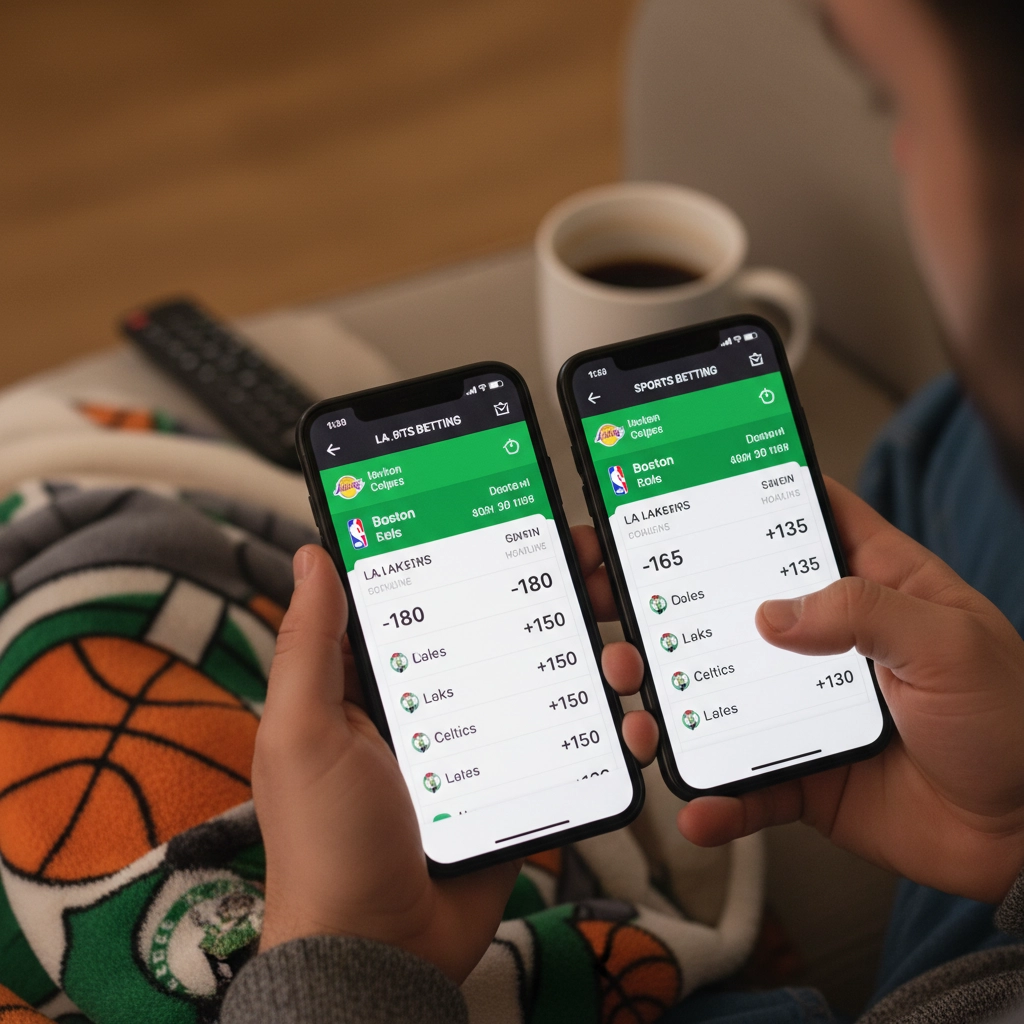
How to quantify expected value on a moneyline
The simplest way to turn a price advantage into a repeatable decision is to calculate expected value (EV). Use decimal odds because they make the math straightforward: decimal odds = 1 + (American positive/100) or 1 + (100/absolute value of American negative). EV per $1 staked = (your estimated probability × decimal odds) − 1. Multiply by your stake to get dollar EV.
Concrete example: you estimate an underdog has a 35% chance to win. Two books show +190 (decimal 2.90) and +210 (decimal 3.10). EV per $1:
– +190: 0.35 × 2.90 − 1 = +0.015 (1.5¢ per $1, or +1.5% edge)
– +210: 0.35 × 3.10 − 1 = +0.085 (8.5¢ per $1, or +8.5% edge)
Those percentages compound over many bets, so the difference between +1.5% and +8.5% is significant. Another quick test is the breakeven probability: 1 / decimal odds. If your probability estimate exceeds that, the bet is +EV.
Keep these practical habits:
– Use a tiny spreadsheet or phone calculator with decimal conversion built in so you can run EV in 15–30 seconds.
– Set a minimum EV threshold for action (more on thresholds below).
– Track closing-line value (CLV) over time: consistently beating the closing line is the best single indicator you have of genuine edge.
Using line movement and timing to improve your prices
Line movement is information. Early moves often reflect sharp money (pro bettors, syndicates) and can signal a genuine value shift. Late moves are frequently public-driven or reactionary to breaking news. Learn the patterns for the leagues you follow: NBA markets move more on injuries and minutes, college markets can be more volatile with less liquidity.
Practical rules for reading movement:
– Early sharp movement away from the open is often worth following—especially at low-vig books—because it compresses value before the public reacts.
– If a line drifts after a flurry of public bets, that can create value to fade (take the opposite side) but requires caution; public money is noisy.
– Significant movement tied to roster/injury news is actionable only after you verify the report and understand how it changes team probability (line moves alone aren’t enough).
Tactics to exploit movement:
– Monitor an odds-aggregation feed plus one or two “sharp” books (those known for low limits and tight pricing) to spot early edges.
– If you’re unsure about a news-driven move, wait 5–10 minutes to confirm—lines often settle into the new consensus.
– Use alerts for games you care about so you can pounce quickly when a favorable line appears.
When to wait and when to lock in the best price
Deciding whether to wait depends on the size of the edge, the volatility of the market, and your stake size. Reasonable rules of thumb:
– If EV > ~5% (or your model shows a clear gap above the breakeven), take the best available price now—don’t risk losing a large edge.
– If EV is modest (1–3%), and you expect news or market movement that could improve the price, it can be worth waiting—but set a cap on how long you’ll wait.
– If EV < 1%, skip it; the variance and transaction costs usually erase such tiny advantages.
Other practical tips: split larger bets across multiple books to capture the best price if you can’t get it all on one book; keep small “ready” balances at the books you use most so you can act instantly; and log every time you wait and the eventual price—this will teach you whether waiting actually helps your results.

Putting the system into practice
Turn the concepts above into a simple routine you can follow each time you bet. Keep the process lean so it becomes habitual rather than a chore.
- Create accounts at three to five reputable books and keep small ready balances at each.
- Use an odds-aggregation tool to spot the best lines, then verify the price in the app before wagering.
- Run a 15–30 second EV check: convert to decimal odds, compare to your probability estimate, and apply your minimum EV threshold.
- Record the bet, the line you took, and the closing line — review monthly to measure closing-line value and refine your approach.
Final notes on building an odds-shopping habit
Making odds shopping part of your routine is less about finding one perfect method and more about discipline and consistency. Protect your edge by acting decisively on meaningful advantages, keeping records, and resisting impulse bets when the math doesn’t justify action. Over time, small price differences compound into real gains if you stay systematic.
For fast line checks and historical movement, consider using an odds-aggregation site such as OddsPortal to supplement the apps you already use.
Frequently Asked Questions
How many sportsbooks should I have accounts with for effective moneyline shopping?
Aim for at least three reputable books to start. That gives enough breadth to find meaningful differences without spreading yourself too thin. As you grow comfortable, add specialized or offshore books that consistently post competitive lines—but keep your balances manageable.
What’s the quickest way to calculate expected value when shopping lines?
Convert the moneyline to decimal odds, then compute EV per $1 as (your estimated probability × decimal odds) − 1. Use a phone calculator, a tiny spreadsheet, or a simple app to automate the conversion so you can run this in 15–30 seconds.
When is it sensible to split a larger bet across multiple books?
Split a stake when the best price is available only in smaller amounts at one book, or when you want to lock partial exposure immediately while chasing a better price elsewhere. Splitting preserves your ability to capture the best available price without missing out entirely when lines move unfavorably.